
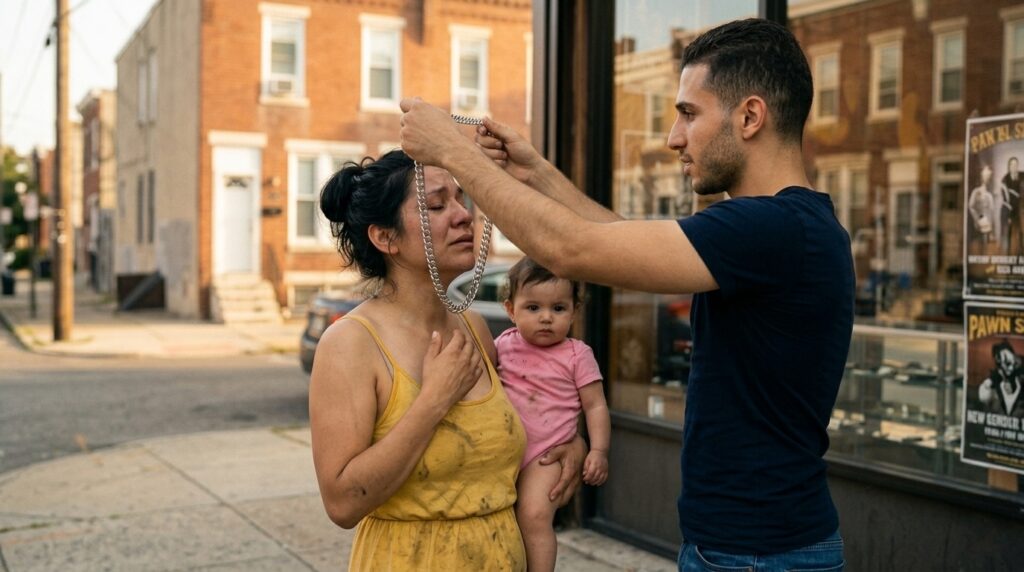
Her hands were shaking when she lifted it over her head.
Not from cold. From the particular weight of doing something you cannot take back.
The chain came off slowly — link by link clearing her collarbone — and she held it in her fist for just a moment before she set it on the glass counter, and in that moment her whole life was in her face for anyone paying attention to see.
The shop sat on a corner of the kind of street that doesn’t make it into anyone’s photographs — brick row houses running the length of the block, cars parked tight against the curb, the particular flatness of a neighborhood that has been working class for so long it has stopped thinking about being anything else. Inside, the air smelled like metal polish and old wood and the faint must of instruments that hadn’t been played in a while. Guitars hung on the wall behind the counter in a row, their bodies catching what light came through the front window. The display cases held rings and watches and chains and the accumulated small tragedies of people who had needed cash more than they had needed things.
Her name was Lucia. She was 29, wearing a yellow sundress that had seen better days — stained at the hem, soft at the shoulders from too many washes — and she was carrying her daughter Maya on her left hip with the automatic ease of a woman who has not put her baby down in months. Maya was eight months old and utterly calm, the way babies are calm when they do not yet understand that anything in the world can go wrong.
Lucia understood. She had understood for a while now.
The chain had belonged to her mother. Silver Cuban link, thick and heavy, the kind that catches light from across a room. Her mother had put it on her the day she turned eighteen and told her to keep it for something important. Lucia had kept it for eleven years through every hard stretch she could remember. This was the hardest stretch she could remember.
She set it on the counter.
The man behind the counter looked up.
His name was Karim. He was 27, lean, with short dark hair and the kind of light stubble that comes from being busy rather than from caring about stubble. He wore a dark navy t-shirt and had the calm, unhurried manner of a man who had been in this shop since he was sixteen helping his uncle and had taken it over three years ago and loved it in the quiet, practical way you love something you have built yourself from someone else’s foundation.
He picked up the chain. He held it up and let it hang from his fingers, the links catching the warm afternoon light filtering through the front window. He turned it once. He examined the clasp. He set it back down.
He looked at the woman on the other side of the glass.
She was wiping her face with the back of her hand. Just once, quick, the way people wipe tears when they have decided they are not going to cry but the decision has come slightly too late. Her lips were pressed together. The baby reached up and touched her cheek.
Karim looked back at the chain.
“How much do you need?” he said.
Lucia told him. He counted out the bills and slid them across the counter. She picked them up and put them in her bag without counting them, because counting them would have meant looking at them, and looking at them would have made it real in a way she wasn’t ready for.
“Thank you,” she said. Her voice was steady. She had practiced being steady.
She picked up Maya and walked toward the door.
Karim stood behind the counter with the chain in his hands.
He looked at it for a long time. He turned it over. He looked toward the door she had just gone through. He looked back at the chain.
There is a transaction and there is a transaction. He had been making transactions his whole working life — buying things people brought in, pricing them fairly, selling them on. It was honest work. He had never once questioned the basic mechanics of it.
He was questioning them now.
The chain was worth more than he’d paid her. Not dramatically more, but more. And she had not negotiated. She had not haggled. She had not done any of the things people do when they know what something is worth. She had just set it on the counter and taken what he offered because she needed it today and she needed it fast and she was in no position to hold out for better.
He set the chain down.
He picked it back up.
He set it down again, and then he did something he had never done in three years of running this shop. He came around from behind the counter, grabbed additional bills from the register, put the chain in his hand, and walked out the front door.
Lucia was halfway down the block when she heard him behind her.
“Hey.” Not loud. Just clear.
She turned. The man from the shop was standing a few feet away, slightly out of breath, the chain in one hand and something else in the other.
She looked at what he was holding.
“I can’t take that back,” she said. “We made a deal.”
“I know,” Karim said. “I’m not asking for it back.” He held out the additional cash first. “I underpaid you. I want to fix that.”
She stared at the bills. “That’s not — you don’t have to — “
“I know I don’t have to,” he said. He said it simply, without drama, the way you say something that is just true. He held the money out until she took it.
Then he held up the chain.
She looked at it. She looked at him. Something moved across her face that was trying very hard not to become what it was becoming.
“I can’t afford to buy it back,” she said quietly.
“I’m not selling it,” Karim said.
He took one step toward her. He lifted the chain carefully — both hands, slowly, the way you handle something that belongs to someone — and lowered it over her head. The links settled on her collarbone. Right where they had always been. Right where her mother had put them eleven years ago.
Lucia’s free hand came up and touched the chain. Her fingers found the familiar weight of it. Her eyes closed.
The baby made a small sound. A pigeon landed on the sidewalk nearby and immediately left. Somewhere down the block a car door closed. The afternoon went on around them the way afternoons do, without noticing.
She stood on that sidewalk with the chain around her neck and the money in her bag and her daughter on her hip, and Karim stood across from her, and neither of them said anything for a moment because there was nothing left to say that the moment hadn’t already said better.
Then she looked at him — really looked at him — and nodded once. The specific nod of someone who has just received something they did not know they needed and do not have words for yet.
He smiled. Small and real. Not performing anything.
He turned and walked back into his shop.
Lucia walked home that afternoon with Maya on her hip and the chain at her collarbone and more money in her bag than she had walked in with, and she kept touching the chain the way you touch something to confirm it is real, because the day had taken a turn she had not been prepared for and her hands needed the confirmation that her mind was still catching up to.
She had walked into that shop ready to let go of the last thing her mother had given her. She had walked out with it still around her neck.
She didn’t know his name. She hadn’t asked. She had been so undone by what he did that the ordinary information had not found its way through.
She found out later — a neighbor who knew the shop told her. Karim. The name meant generous in Arabic. She looked that up when she got home, standing in her kitchen with Maya on her hip and the chain at her throat and the particular quietness of a woman who has just learned that some people are exactly who their name says they are.
There are things you carry for years because you were told to keep them for something important. Most of the time you never know what that something is.
Sometimes it turns out the important thing wasn’t what you were going to do with the chain. It was what came back to you when you tried to let it go.
This story was inspired by one of our viral videos. Watch the original reel below and follow KindnessHQ for daily stories that restore your faith in humanity.
This story is a fictional narrative inspired by real themes of kindness and humanity. Any resemblance to actual events or persons is coincidental.