
The boy could play.
Anyone within half a block could tell you that much — could feel it in the soles of their shoes before they even rounded the corner. The rhythm was coming up through the concrete, steady and syncopated and completely alive, and it was coming from a nine-year-old sitting cross-legged on the curb with two plastic buckets and a wooden stick, making something out of nothing the way only certain people can.
His father sat on the step behind him, smiling with his whole face.
The street was the kind of suburban block that looks the same from every angle — single-family homes set back from the road, power lines threading between the trees, the particular golden stillness of a late afternoon in a neighborhood where the kids are still outside and the sprinklers haven’t come on yet. It smelled like cut grass and warm pavement. Down the block someone was running a lawnmower. Up the block, a dog was making a considered argument about something. And right here, on this particular square of concrete curb, a boy named Isaiah was playing the best show on the street.
Isaiah was nine. He was wearing a bright blue t-shirt and grey sweatpants and sneakers that had seen a full school year, and he had the focused, transported expression of someone who is completely inside the music — eyes half-closed, head nodding, stick moving between the two buckets with a precision that shouldn’t have been possible from a kid who had never had a lesson in his life.
His father Marcus sat two steps up on the front porch, leaning forward with his elbows on his knees and his tattooed arms folded and his eyes on his son, and his expression was the one fathers wear when they are watching something that belongs entirely to their child — not pride exactly, something bigger than pride, something that sits just behind the sternum and doesn’t have a clean word for it.
That was the afternoon. That was the whole world, for about twenty minutes.
Then the police cruiser came down the street.
Officer Dan Whitfield was thirty-eight, clean-cut, navy uniform, the kind of cop who had been on this beat long enough to know every block and every face on it. He pulled up slowly, the way patrol cars pull up when there is no emergency but there is something that needs addressing. He stepped out and looked at the boy on the curb and the buckets and the stick and the father on the step, and he put his hands on his belt.
Marcus was on his feet before Whitfield had said a word. Not aggressive. Just present. The particular alertness of a father who has learned to read situations quickly and is reading this one.
“What’s the issue, Officer?” Marcus said.
“Noise complaint,” Whitfield said. He looked at Isaiah, who had stopped playing and was looking up at him with the wide, careful eyes of a child trying to understand what he had done wrong. “I need to take the buckets.”
Isaiah looked at his father. Marcus looked at the officer. A long beat passed.
“Those are just buckets,” Marcus said quietly.
“I understand that,” Whitfield said. “I still need to take them.”
Isaiah stood up slowly. He looked at the buckets — the blue one he’d had for two years, the white one he’d found behind the neighbor’s house, the green one that was just the right height. He looked at the officer. He set the stick down on the curb and stepped back.
Whitfield picked up the buckets. He put them in the trunk of the cruiser. He got back in without another word, and the car pulled away down the street, and Isaiah stood on the curb and watched it go until it turned the corner and disappeared.
Then he sat back down on the concrete. Without the buckets. Without the stick. And he started to cry — not dramatically, not with any performance in it, but the quiet, chest-deep crying of a child who has had something taken that mattered, and who does not yet know that the world ever gives things back.
Marcus sat down beside him on the curb. He didn’t say anything. He just put his arm around his son and sat there with him in the golden afternoon while Isaiah cried.
Six blocks away, Officer Dan Whitfield sat in the parking lot of a sporting goods store with the engine running.
He had been sitting there for four minutes.
He had driven away from that curb with three plastic buckets in his trunk and a noise complaint to close out, and somewhere in the six blocks between there and here something had shifted in the way things shift when you’ve done the technically correct thing and it sits wrong anyway. He kept seeing the boy’s face when he’d stepped back from the buckets. The way he’d set the stick down without being asked. The way he hadn’t argued, hadn’t complained, had just — stepped back. Nine years old and that composed.
Whitfield got out of the car.
He went into the store and walked to the back where the instruments were. He stood in front of a junior drum kit for a long moment — chrome hardware, black finish, bass drum and snare and hi-hat and one crash cymbal, everything a kid needed to stop playing on buckets. He checked the price. He thought about it for approximately three seconds.
He brought it to the register.
The woman at the counter tied a red ribbon around it. She didn’t ask why. She just tied it.
Isaiah was still on the curb when the police cruiser came back down the street.
He heard it before he saw it — the engine, the slow roll of tires, the sound of a car that is not in a hurry. He looked up. Marcus stood up behind him.
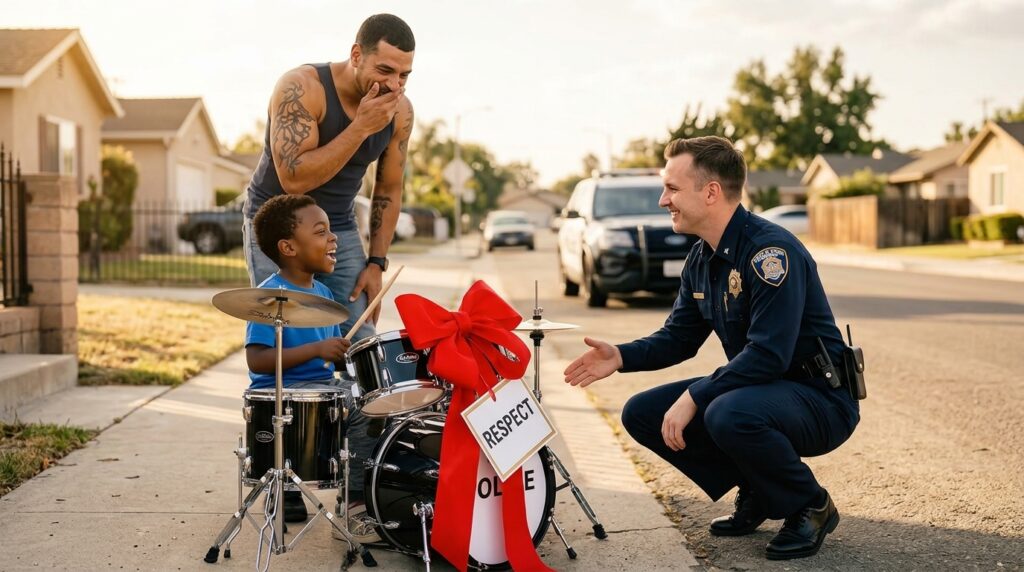
The cruiser came to a stop in front of the house. And on the roof of the car, tied with a red ribbon that caught the late afternoon light, was a drum kit.
Isaiah went completely still.
He looked at it the way you look at something when your brain has not yet given your body permission to react — the specific frozen second before joy arrives fully. Then Whitfield stepped out of the car, and he was smiling the real smile, the one that has nothing professional in it, and he lifted the drum kit down from the roof and carried it to the curb and set it in front of Isaiah without a word.
Isaiah looked at the drums. He looked at the officer. He looked at his father, who was standing with his hand over his mouth.
Then Isaiah threw his arms around Officer Whitfield and held on.
Whitfield held on back. His hand on the back of the boy’s blue t-shirt, his eyes closed for a second, the red ribbon on the drum kit catching the last of the golden hour light behind them.
When they separated, Whitfield crouched down to Isaiah’s level and held out his hand.
Isaiah shook it. Firm. Real. The handshake of a kid who has just been treated like someone whose talent matters, and who is registering that information in a way he will not forget.
“You’ve got something,” Whitfield said. “Don’t stop playing.”
Isaiah nodded. He sat down behind the drum kit on the curb — right where he’d been sitting with the buckets an hour earlier — and picked up the sticks that came with it, and he played. Not tentatively. Not quietly. He played the way he always played, but louder now, and cleaner, and with a kit that could hold everything he was putting into it.
Marcus stood on the step behind him with his arms folded and his eyes bright and the expression back on his face — the one that sits behind the sternum and doesn’t have a word.
Whitfield leaned against the cruiser and listened for a while before he got back in and drove away.
The block heard every note.
There is a version of that afternoon where the cruiser turns the corner and keeps going and the buckets end up in a city storage facility somewhere and Isaiah grows up playing on whatever he can find, which is what he would have done anyway because that is the kind of kid he is.
But Dan Whitfield sat in a parking lot for four minutes and thought about a boy who had stepped back from his buckets without being asked, and he went into a store, and he tied a ribbon, and he came back.
That is the whole distance between a story that ends on a curb and a story that doesn’t.
Isaiah played until the streetlights came on. His father watched from the step. The neighbors came out to listen. The lawnmower down the block stopped, and for a while the only sound on the street was a nine-year-old boy with a real drum kit and something to say.
He had plenty to say.
He always had.
This story was inspired by one of our viral videos. Watch the original reel below and follow KindnessHQ for daily stories that restore your faith in humanity.
This story is a fictional narrative inspired by real themes of kindness and humanity. Any resemblance to actual events or persons is coincidental.