
The wooden plank groaned under the weight of the two boys, teetering on a mossy log that had seen better decades. Dust kicked up with every rhythmic thump against the dirt, painting their jeans in shades of concrete grey. Down the alley, the neighborhood rumbled with the distant, low-frequency hum of a city that never really sleeps, but here, in this narrow strip of pavement, Leo and Jamal had carved out their own kingdom. The alley was a corridor of rusted metal and forgotten history. A chain-link fence, sagging under the weight of invasive vines, lined one side, while the brick walls of old apartment buildings rose up like fortress walls on the other. It smelled of stale city air—a mixture of hot asphalt, damp paper, and the sharp, metallic tang of something decaying in the rain.
Leo, small for his age but quick with a laugh, pushed off the ground, sending Jamal soaring upward. Their laughter echoed off the brick, a bright sound against the drab, grey reality of their street. They didn’t have much, just this makeshift seesaw that wobbled dangerously with every swing. To them, it wasn’t a death trap or an eyesore; it was freedom. It was the only place in the world where they could forget the locked doors, the broken streetlights, and the constant, underlying tension of their environment.
A shadow fell over them. It wasn’t the passing of a cloud, but the slow, heavy creep of a patrol car turning into the mouth of the alley. The engine purred with a low, menacing growl that seemed to vibrate through the soles of their sneakers. The laughter stopped instantly. The boys froze, their feet dangling inches above the dirt, eyes locked on the black and white vehicle as it rolled to a halt. The red and blue lights, though not flashing, loomed like dormant eyes.
The driver’s side door opened with a metallic click that echoed against the brick walls, sounding louder than the traffic on the main road. An officer stepped out, followed closely by his partner. They were tall, imposing figures in dark uniforms, their boots crunching on the gravel. Leo and Jamal didn’t move. Fear, cold and sharp, coiled in their chests. In a neighborhood where authority was often associated with bad news, the arrival of the police felt like a storm brewing. They braced themselves for the reprimand, for the order to disperse, for the harsh words they had heard so many times before.
The officers didn’t stop to lecture. They walked straight to the wooden plank and the log. One officer gripped the wood, testing its weight, his face unreadable. He looked at the boys, his gaze scanning their dirt-streaked faces, and then he looked at his partner. A silent conversation passed between them, a look that conveyed more than a dozen shouted commands ever could. With a grunt of effort, the officers hoisted the plank up.
“We’re taking this,” the male officer said, his voice firm but not angry.
“But—” Jamal started, his voice cracking, but he stopped when he saw the officer’s steady eyes.
The officers heaved the plank toward the back of the alley, where a massive, overflowing dumpster sat behind a pile of sodden cardboard. With a heavy, echoing thud, the wooden plank—their seesaw, their kingdom, their only joy—was tossed into the garbage. It disappeared into the mess of refuse. Leo stared at the dumpster, feeling a profound sense of loss, a hollow weight settling deep inside his stomach. He looked at Jamal, who had turned away, his shoulders slumped in defeat. The officers had just taken the only thing they had, leaving them with nothing but the empty space where their fun used to be.
The officers turned back to them, their expressions unreadable. They didn’t smile, and they didn’t offer an explanation. They simply gestured toward the open doors of the patrol car. The boys hesitated, glancing back at the alley entrance. They were afraid to get in, afraid of where this was going, but there was no choice. They climbed into the backseat, the leather feeling cold and stiff against their legs. The heavy steel mesh between the front and back seats felt like a cage, amplifying the silence between them.
The car began to move, rolling slowly out of the alley and into the broader, busier streets. The boys sat huddled together, watching the familiar neighborhood blur past the window. They didn’t talk. They didn’t ask where they were going. They were just waiting for the next bad thing to happen, waiting to see what punishment awaited them. The city moved by in a blur of neon signs and crowded storefronts, a world that felt disconnected from their own.
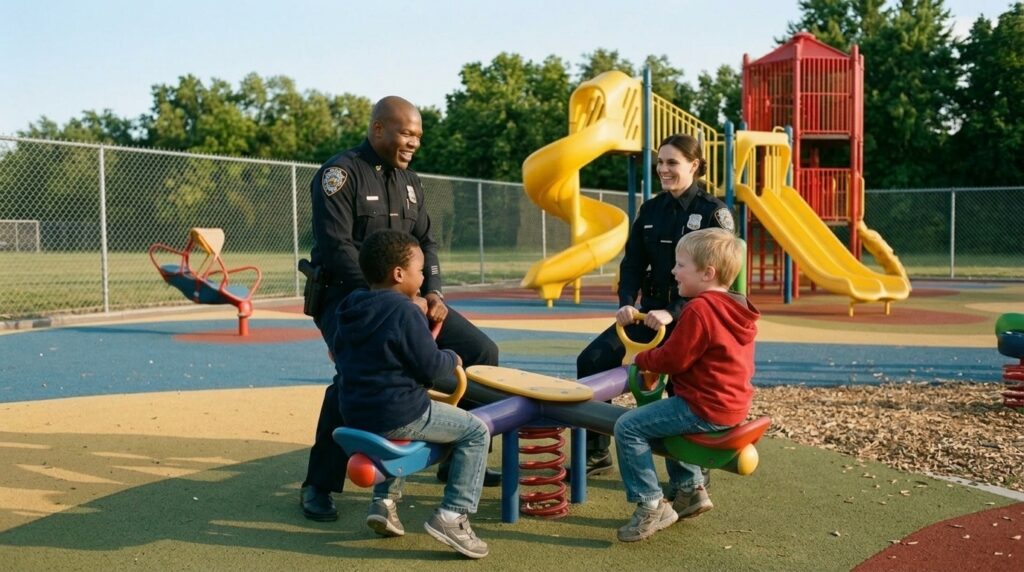
The car took a turn, then another, moving away from the industrial grit and toward an area where the trees were greener and the houses had manicured lawns. The car slowed, turning into a space that seemed like a different universe. They pulled into a park. It was a kaleidoscope of color—bright yellow slides, vibrant red climbing structures, and, in the center, a perfectly maintained, modern seesaw with smooth plastic seats and sturdy steel springs.
The officer parked the car and killed the engine. The silence that followed was different this time; it was peaceful, heavy with anticipation. They opened the doors and stepped out. Leo and Jamal climbed out, their eyes wide, taking in the scene. The air here smelled of freshly cut grass and pine, a sharp, clean scent that cleared their heads. They looked at the new equipment, then back at the officers, who were now smiling, their posture relaxed and friendly.
“Go on,” the officer said, gesturing to the playground with a broad sweep of his arm.
Leo didn’t wait. He ran toward the seesaw, Jamal right behind him. They climbed onto the seats, feeling the difference immediately. It was stable, safe, and built for play, not for survival. They began to rock, and the movement was fluid, effortless, and joyous. The laughter returned, louder and freer than it had ever been in the alley. The officers didn’t stand back and watch with authority; they walked over, leaning against the frame, laughing along with the boys.
The turning point hit them in that moment. The fear that had been lodged in their throats dissolved, replaced by the realization that the people they feared were actually there to build them up. The world hadn’t just taken something away; it had traded a broken piece of wood for a foundation. They weren’t just playing; they were safe. They were seen. They were important enough to be brought here, to be given a better version of what they had lost. The officers, by destroying the dangerous, makeshift toy, had removed the obstacle to real, secure joy. It wasn’t about the law or the rules; it was about the simple, profound act of caring enough to make sure these boys had a place to be kids, not just survivors in an alleyway.
As the afternoon sun dipped low, casting long, golden shadows across the rubber flooring of the park, the boys continued to rock back and forth. They weren’t thinking about the alley, the trash, or the life they were used to. They were living entirely in the moment. It was a reminder that sometimes, to receive something better, you have to let go of the things that were holding you back, even if they felt necessary at the time. The officers stood there, no longer imposing figures of the law, but guardians of a fleeting, precious afternoon. In a world that often feels indifferent, that small exchange proved that there is always room for a shift in perspective, a change in trajectory, and the simple, quiet power of showing someone they matter.
This story was inspired by one of our viral videos. Watch the original reel below and follow KindnessHQ for daily stories that restore your faith in humanity.
This story is a fictional narrative inspired by real themes of kindness and humanity. Any resemblance to actual events or persons is coincidental.