
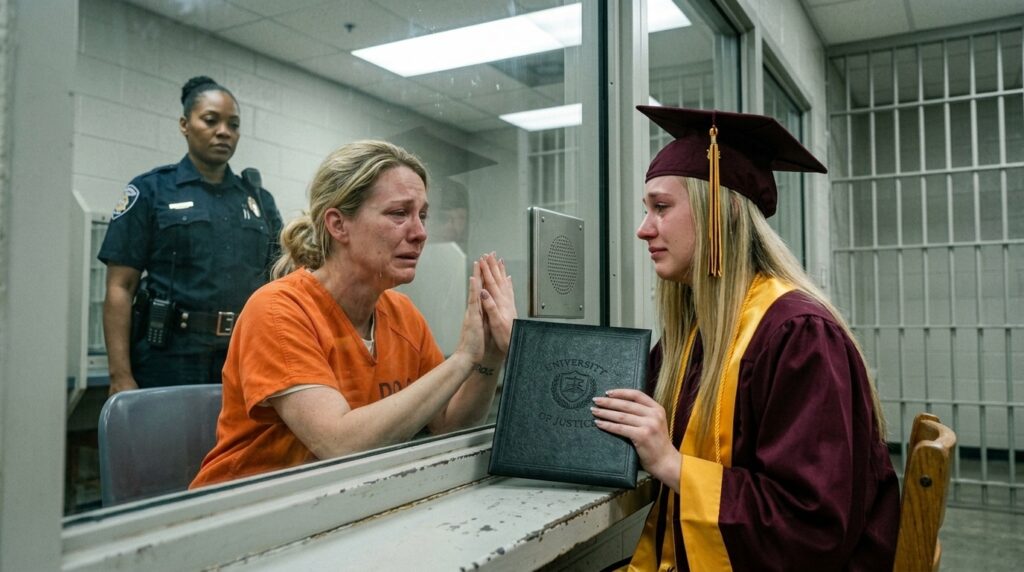
The cold glass divider was the only thing standing between them, a transparent wall that felt as thick as a tombstone. Sarah sat in her graduation cap and gown, tears carving clean tracks through her makeup, staring into her mother’s hollowed eyes. It was the biggest milestone of her life, yet standing in that sterile room, it felt more like a funeral than a celebration.
The visiting room was a place where time didn’t just stand still; it withered. The air smelled of industrial floor wax, stale coffee, and the metallic odor of too many locked doors and barred windows. A low, constant hum emanated from the fluorescent lights overhead, a sound that drilled into the back of one’s skull. Sarah clutched the black diploma case against her chest, her fingers trembling against the fake leather. She had spent the last four years imagining this moment—not the stage, not the cheering crowd, but the look on her mother’s face when she finally saw her succeed.
Her mother, Elena, looked smaller than Sarah remembered. The bright, unnatural orange of the prison jumpsuit drained the color from her skin, making her look like a ghost inhabiting a space she didn’t belong in. Elena’s hands were pressed against the glass, matching the position of Sarah’s own hands on the other side. They were separated by a quarter-inch of reinforced material, a barrier that represented every mistake, every choice, and every mile of separation that had defined their lives for the last few years.
“I did it, Mom,” Sarah whispered, her voice cracking as she pressed her lips to the glass, trying to bridge the gap with nothing but sound. “I finished. I have the paper right here.”
Elena’s eyes were bloodshot, her face tight with a mixture of agony and pride that threatened to break her composure. She couldn’t say the words she wanted to say—the “I’m sorry,” the “I love you,” the “You shouldn’t have had to do this alone.” She just leaned her head against the partition, letting the tears fall freely now, uncaring of how she looked to the other visitors. “You look so beautiful,” Elena finally managed to choke out, her voice thin and raspy. “I’m so sorry I wasn’t there to see you walk. I’m so sorry I couldn’t be the mother you deserved.”
The conversation was sparse, punctuated by the awkward, painful silence of things left unsaid. Every minute that ticked by on the wall clock felt like an hour of lost time. Sarah held up the diploma case to the glass, showing the embossed gold lettering. It was a tangible object, a shield against the shame, a proof of existence. Elena reached out, her fingertips tracing the outline of the case on the glass, as if she could pull the achievement through the partition by sheer force of will.
In the corner of the room, Officer Jenkins stood motionless. She was a woman of few words, known for running the visiting block with a strict, unwavering adherence to the rulebook. Her uniform was crisp, her demeanor professional and detached. She had seen thousands of visits in this room. She had seen the anger, the manipulation, the desperate pleas, and the hollow goodbyes. But she had never seen this specific combination of grief and triumph.
Jenkins watched the mother and daughter. She saw the graduation cap—the symbol of a future being built—clashing with the drab reality of the prison. She saw the way Sarah tilted her head, trying to capture a memory of her mother’s face to take back to the outside world. She saw the way Elena’s shoulders shook with silent sobs. It wasn’t just a visit; it was a surrender. A surrender of the pain that had kept them apart, and a fragile attempt to acknowledge that life had moved forward despite the iron bars.
The clock on the wall struck the hour. The chime was faint, but it signaled the end. The protocol was simple: the visit concludes, the inmates are processed, and the visitors are escorted out. Jenkins knew exactly what she was supposed to do. She was supposed to step forward, announce the end of the visit, and usher Sarah out of the facility. She was supposed to be the wall that separated them.
“Time’s up,” she said, her voice echoing in the small, partitioned booth.
Sarah pulled back as if she had been burned. She looked at her mother, her eyes wide with a panicked, desperate plea. She wasn’t ready. She would never be ready to walk away. She clutched the diploma case so hard her knuckles turned white, her whole frame sagging under the weight of the realization that this was it—the milestone was done, and they were still worlds apart.
Elena pulled her hands away from the glass, her face a mask of crumpled sorrow. She stood up, her movement slow and defeated. She cast one last look at her daughter, a look that conveyed a lifetime of regret, before turning to face the wall. She knew the routine. She had learned how to exist in the smallest of spaces, how to shrink herself down until she was barely noticeable, how to endure the ending of every single visit.
Sarah began to cry, not quiet tears, but deep, racking sobs that shook her thin frame. She gathered her things, the diploma case tucked under her arm, feeling the cold air of the prison hallway biting at her skin. She had wanted so much more. She had wanted to show her mother that she had made it, to hear her voice without the distortion of the glass, to feel her arms around her shoulders just once. She turned to leave, her feet heavy, moving toward the exit that led to a life that felt far too big and empty without her mother in it.
Officer Jenkins stood by the door, her keys jangling faintly against her belt. She watched the girl’s retreating form and then looked back at the inmate, who was standing perfectly still, staring at the empty chair on the other side of the glass. The silence in the room was absolute. There was no sound of shuffling feet, no chatter of other visitors, just the heavy, suffocating weight of two lives suspended in misery. Jenkins looked at the door, then back at the mother. Something about the sight—the gown, the diploma, the sheer raw honesty of their separation—tripped a wire in her conscience that she usually kept firmly locked away.
Officer Jenkins took a breath, moved to the door, and unlocked the heavy iron latch with a sharp click. She turned to Elena and gestured toward the room, her expression softening into a rare, human warmth. “Go ahead,” the officer said quietly, holding the door wide. Sarah spun around, her eyes widening in disbelief, and Elena rushed forward, the two women colliding in an embrace that transcended the sterile, gray walls of the prison.
There are moments in life where the rules are merely suggestions, and mercy is the only law that truly matters. In that small, cold room, the bars didn’t disappear, and the sentence wasn’t shortened, but for a few seconds, the weight of the world was lifted. Sometimes, the greatest act of justice isn’t found in a courtroom or a policy manual, but in the decision to see the person behind the number and the human heart behind the glass. We are all, in some way, waiting for someone to unlock the door.
This story was inspired by one of our viral videos. Watch the original reel below and follow KindnessHQ for daily stories that restore your faith in humanity.
This story is a fictional narrative inspired by real themes of kindness and humanity. Any resemblance to actual events or persons is coincidental.