
The liquid hit Elias like a cold slap, soaking his orange high-visibility uniform in seconds. The acrid smell of burnt espresso mingled with the damp, heavy scent of city trash as the liquid dripped down his chin. Elias stood paralyzed on the curb, his breath hitching, while the sharp, piercing laughter of the couple echoed off the surrounding brick buildings. They didn’t even look back as they strolled away, moving through the bustling downtown street as if they owned the very air others were breathing.
It was a Tuesday afternoon, the kind where the heat radiates off the asphalt in shimmering, dizzying waves. The city sounded like a chaotic symphony—honking horns, the grinding gears of a bus, and the dull roar of a million footsteps on concrete. Elias, a man whose hands were mapped with the callouses of twenty years of labor, wiped the coffee from his forehead with the back of a gloved hand. He wasn’t a man who looked for trouble. He was a man who worked, who went home to his family, and who kept his head down.
But something about the casual cruelty of it—the way the woman had tossed the cup without even breaking her stride, the way her partner had grinned as if it were the funniest thing he’d seen all week—ignited a fire in Elias’s chest. He didn’t think about his job. He didn’t think about the consequences. He simply started walking. He followed them, his heavy work boots striking the pavement with a rhythmic, determined thud. He needed to know why.
The sidewalk was crowded, forcing Elias to weave through the throngs of tourists and office workers. He caught up to them near a sleek, orange convertible that looked like it belonged on a showroom floor rather than a grime-streaked city street. They were still laughing, their voices rich and untroubled. Elias stepped into their path, his face set in a grim line, the wet orange fabric of his jumpsuit clinging to his skin.
“Excuse me,” Elias said, his voice gravelly but steady. “I’d like to know why you thought that was funny. What did I ever do to you?”
The man stopped, turning to face Elias. He was dressed in a tailored suit that cost more than Elias made in a month, his expression shifting from amusement to cold, sharp annoyance. He didn’t see a person; he saw an obstacle, a piece of debris that had dared to interrupt his day. He scoffed, looking Elias up and down with blatant, ugly disdain.
“You’re in my way, pal,” the man replied, his voice dripping with condescension. “Maybe if you spent less time staring and more time cleaning, you wouldn’t be standing there smelling like a dumpster.”
Elias took a half-step forward, his hands balling into fists at his sides. He wasn’t violent, but he had dignity, and that dignity had been shredded in front of dozens of people. The woman beside the man rolled her eyes, checking her watch with an impatient sigh. She looked at Elias as if he were a bug she wanted to scrape off her shoe.
“Just walk away,” the woman added, her tone sharp. “Nobody cares about you.”
The man reached out, shoved Elias hard in the chest, and sent him stumbling backward. Elias tripped over the uneven curb, hitting the pavement hard. The breath left his lungs in a painful rush. He lay there for a moment, the grit of the sidewalk digging into his palms, listening to the click-clack of the couple’s expensive shoes as they hurried to get into their car. They thought they had won. They thought they had asserted their dominance in the hierarchy of the street.
People around them stopped. The crowd, which had been indifferent moments before, suddenly shifted. Eyes turned toward Elias on the ground, then toward the couple climbing into the convertible with smug, satisfied grins. A young woman in a denim jacket walked over to Elias, helping him to his feet. Others gathered, their faces darkening as Elias pointed a shaking, grease-stained finger toward the luxury car. The whispers started—indignant, angry, and growing louder with every passing second.
The man in the suit slid behind the wheel, revving the engine with a loud, aggressive roar. He didn’t notice the circle closing in around his vehicle. He was too busy adjusting his sunglasses, satisfied with his display of power. The woman laughed again, checking her hair in the mirror, oblivious to the fact that the atmosphere on the street had turned. The pedestrians weren’t just watching anymore; they were observing. They were judging. And they were deciding that the scales needed to be balanced.
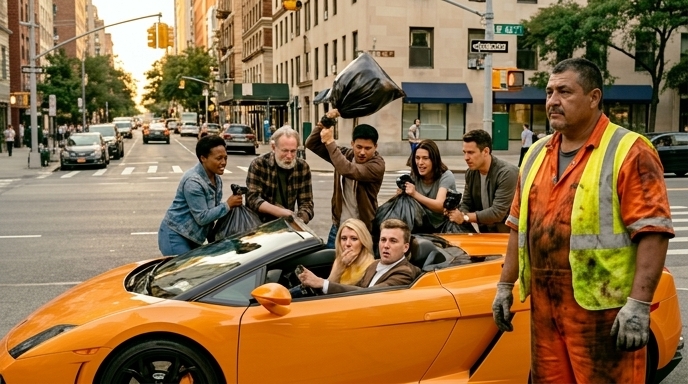
The car sat idling, trapped by the heavy afternoon traffic. It was the perfect moment. The bystanders moved not with aggression, but with a synchronized, quiet purpose. They walked to the curb, reaching into the heavy, black plastic bags that lined the street. There was no hesitation. They gathered the bags—full, heavy, and ripe with the remnants of the city’s day—and moved toward the convertible.
The man looked up, his smile fading as he saw the wall of people surrounding his car. He didn’t have time to react. He didn’t have time to speed away. The bags descended. With a collective heave, the bystanders emptied the contents directly into the open cabin of the orange sports car. Coffee grounds, banana peels, discarded wrappers, and all the forgotten refuse of the day rained down upon the pristine leather seats and the man’s expensive suit.
The man in the suit shouted, trying to wave the debris away, but it was useless. The woman screamed, scrambling to shield her face as a second wave of trash landed on the dashboard. The luxury vehicle was transformed, filled with the very thing the man had been so disgusted by only moments before. He was no longer a person of status; he was a person covered in the literal garbage of the people he had looked down upon.
The crowd stepped back, their faces stoic. Elias stood on the sidewalk, watching, his pain forgotten. The man in the convertible fumbled with the gear shift, his face red with a mix of fury and pure, unadulterated shame. He didn’t make eye contact. He couldn’t. He looked at the windshield, then at the street, and he drove off, the car trailing bits of refuse behind it like a wake of failure. The street fell silent, the symphony of the city continuing as if nothing had happened, leaving only the memory of the lesson hanging in the humid air.
True respect is not found in the clothes you wear or the car you drive. It is found in how you treat the people who are invisible to everyone else. The man in the suit learned that status is fragile, easily dismantled by the very people he deemed beneath him. As Elias turned back to his work, he knew that the stain on his uniform would wash out, but the look on that man’s face—the realization that his arrogance had finally met its match—was something that would remain long after the trash was cleared away.
This story was inspired by one of our viral videos. Watch the original reel below and follow KindnessHQ for daily stories that restore your faith in humanity.
This story is a fictional narrative inspired by real themes of kindness and humanity. Any resemblance to actual events or persons is coincidental.