
He Grabbed It Right Out of the Man’s Hands.
The bag was already open. Marcus had barely had time to look inside.
And just like that — it was gone.
The parking lot outside Mercy General Hospital smelled the way hospital parking lots always do: exhaust fumes, a faint trace of fast food grease drifting from somewhere nearby, and underneath it all, that particular staleness that comes from too many people sitting in too many cars, waiting on news they’re not sure they want to hear. It was mid-afternoon on a Tuesday. The kind of day that drags. A few pigeons picked at something near the curb. A woman in scrubs power-walked toward the entrance without making eye contact with anyone.
Marcus Webb had been sitting on that wooden bench for three hours. He was 58, lean in the way that comes from hunger rather than choice, with a graying beard that hadn’t seen a razor in weeks. His jacket was two sizes too large and had a tear near the left pocket he’d sewn up himself with black thread that didn’t quite match. He had nowhere to be. That was the thing about being homeless — you had nowhere to be, but somehow the days still filled up.
He’d found the McDonald’s bag near the trash can. Someone had tossed it a foot short, and it had landed upright, which felt like a small miracle. He’d reached down, picked it up, and settled back onto the bench.
Inside: two bags of fries, still warm. A half-eaten Big Mac wrapped back up, careful as if someone had meant to come back for it.
Marcus didn’t think twice. He unwrapped the burger and took a slow, deliberate bite.
That’s when the man in the blue suit appeared.
He was tall, maybe 45, with the kind of posture that comes from never having to apologize for taking up space. The suit was the deep blue of a clear sky right before dusk — fitted, expensive, the kind you don’t buy off a rack. He was walking toward the far end of the lot, car keys already in hand, when something made him glance over.
He stopped.
He looked at Marcus. He looked at the bag.
His jaw tightened.
The man walked over with long, purposeful strides and without a word, reached down and took the bag right out of Marcus’s hands. Not aggressive. Not cruel, exactly. Just — decided. The way a man acts when he believes he is simply correcting a small error in the world.
He dropped the bag in the trash can. The one it had originally missed.
Marcus stared at the ground. He didn’t say anything. There wasn’t anything to say. He’d been invisible to people his whole life in this part of town — this was just a more direct version of that.
The man in the blue suit turned and walked back toward his car.
It was a G-Class Mercedes. Black. Immaculate.
The kind of car that costs more than most people’s houses.
An older woman who’d been loading groceries into her sedan two spots down had seen the whole thing. She shook her head slowly, looked over at Marcus with an expression that mixed pity and helplessness in equal measure, and then looked away. What do you do? What do you say? To the man in the suit, she was nobody. To Marcus, she was just another person who watched and moved on.
Marcus sat back down on the bench. He folded his hands in his lap. He closed his eyes for a moment, not in prayer exactly, but in the particular kind of stillness that comes when you’ve been knocked down often enough that you stop expecting the ground to feel different.
The lot was quiet. Somewhere a car engine turned over. A pigeon landed near his shoe and immediately lost interest.
He heard footsteps.
He didn’t open his eyes.
“Hey.”
The voice was low. Close.
Marcus opened his eyes.
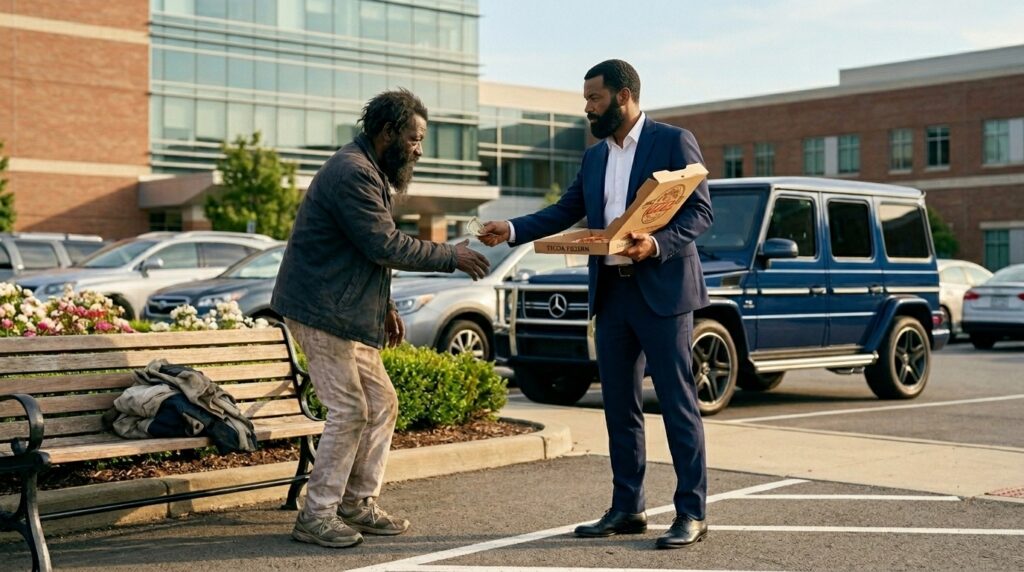
The man in the blue suit was standing in front of him. But something had shifted. He wasn’t carrying the same posture anymore. He was holding a pizza box in one hand — a large, flat box from the smell of it, still hot — and a folded bill in the other. His face had changed in the way a face changes when a person has just finished having an argument with themselves. And lost. Or maybe won. It’s hard to tell the difference sometimes.
“I had this in my car,” the man said, holding out the box. “It’s for you. I mean — if you want it.”
Marcus looked at the pizza. He looked at the man.
“You just took my lunch,” Marcus said. His voice was quiet, not accusatory. Just stating a fact.
“I know.” The man didn’t look away. “I thought you’d stolen it. I didn’t — I didn’t stop to think. I should have stopped to think.”
His name was Daniel Reeves. He’d later tell his wife it had been the walk back to the car that did it. Ten seconds of silence where he’d heard himself clearly for the first time in a while. That man was hungry. And you took his food. And you felt good about it.
He’d bought the pizza two hours earlier from a place on Fifth — one of those thin-crust spots he liked, planning to eat it at his desk while catching up on calls. It was sitting on the back seat, still in the box. He’d grabbed it before he’d fully decided what he was doing.
He’d also pulled out his wallet.
He held out both — the pizza box balanced on one palm, three folded fifties in the other.
Marcus stood up slowly. He took the box. He looked at the money.
“I don’t need—”
“Please,” Daniel said.
A pause stretched between them that held everything neither man knew how to say. Then Marcus reached out and took the bills and tucked them into his jacket pocket. Daniel exhaled like he’d been holding that breath for the last five minutes.
Then Marcus did something Daniel didn’t expect.
He extended his hand.
Daniel took it. They shook — a real shake, firm and level, the kind that means something.
“Thank you,” Marcus said.
“I’m sorry,” Daniel said. “I mean it.”
“I know you do.”
The woman with the groceries was still there. She’d stopped what she was doing a while back. She didn’t say anything. She just watched the two men standing in the parking lot with a pizza box between them, and felt something loosen in her chest that she couldn’t have named if she tried.
Daniel Reeves got back in his G-Class and sat for a moment before starting the engine. He didn’t know Marcus Webb’s name. He didn’t know his story. He didn’t know about the years of construction work, or the accident, or the months of medical bills that had quietly swallowed everything Marcus had ever saved. He didn’t know about the daughter in Phoenix who didn’t know her father was living out of a storage unit.
He just knew the look on the man’s face when he stood up to shake his hand.
Not gratitude. Not relief. Something older and more important.
Dignity.
There are moments in a parking lot, in the middle of an ordinary Tuesday, that don’t make the news and don’t go in anyone’s highlight reel. Nobody applauds. Nobody films it and it never goes viral. Two men stand in the afternoon light and something passes between them that neither one will fully be able to explain later.
But Marcus ate hot pizza on that bench for the next hour.
And Daniel drove home a slightly different man than the one who’d parked there that morning.
Sometimes that’s the whole story. And sometimes that’s enough.
This story was inspired by one of our viral videos. Watch the original reel below and follow KindnessHQ for daily stories that restore your faith in humanity.
This story is a fictional narrative inspired by real themes of kindness and humanity. Any resemblance to actual events or persons is coincidental.