
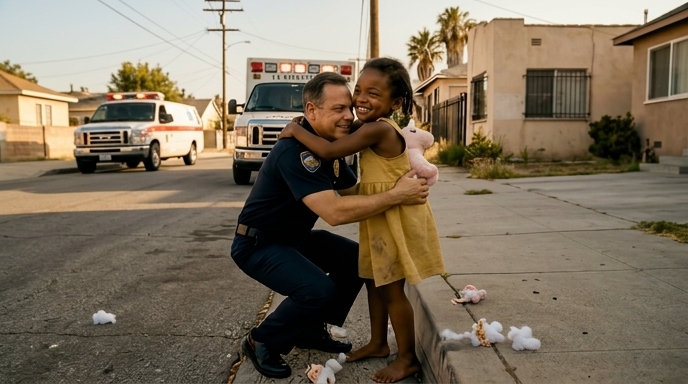
The unicorn’s head was hanging by a thread.
Sofia held it against her chest anyway, the way you hold something you’re not ready to let go of, even when it’s already gone. She was five years old and sitting on the curb outside her building, and the world had never felt quite so large or so indifferent.
Nobody stopped.
The sidewalk that afternoon had the particular energy of a city that doesn’t slow down for small heartbreaks. Shoes clicked past on the pavement. A bus hissed to a stop half a block away and then lurched forward again. The air smelled like warm concrete and the tail end of someone’s lunch from a window above. Sofia sat in the middle of all of it, turning the stuffed unicorn over in her hands, pressing its cotton body together where the seam had torn, and then watching it fall apart again.
The unicorn had been white once. Now it was the off-white of something deeply loved — rubbed soft at the ears, slightly gray at the hooves, with one eye that had faded to a pale suggestion of blue. Her mother had given it to her at Easter. That detail mattered to Sofia in the way that details matter to children, which is to say completely and without qualification.
She didn’t make a sound. She just sat there, shoulders caved inward, holding the two pieces of her broken thing.
That’s when she heard the siren.
The ambulance came around the corner at a pace that suggested it wasn’t racing to an emergency — just making its way through the afternoon. It was a Tuesday. Paramedic Jonah Reyes was in the passenger seat, window cracked, one elbow resting on the door. He was 34, still in that phase of the job where you notice things other people stop seeing after a few years on the rotation.
He noticed Sofia.
“Hold on,” he said.
His partner, a woman named Dara who had been driving this route for eleven years and had seen most things, glanced over. “What?”
“Just — pull over for a second.”
Dara looked at the little girl on the curb. She pulled over.
Jonah climbed out with his hands in his pockets, the way you approach a small animal you don’t want to startle. He crouched down a few feet from Sofia and looked at what she was holding.
“Hey,” he said. “What happened to your friend?”
Sofia looked up. She assessed him the way children assess strangers — quickly, thoroughly, and without pretense. He had kind eyes. She decided that was enough.
“She broke,” Sofia said. She held up the unicorn’s detached head as evidence. “Her name is Luna.”
Jonah took the head gently in both hands and examined it with the focused expression of a man consulting a patient chart. He turned it over. He pressed the edges of the torn seam together. He looked up at Sofia with the particular gravity of someone delivering a diagnosis.
“Luna needs surgery,” he said.
Sofia’s eyes went wide. “Is she going to be okay?”
“We’re going to do everything we can,” Jonah said. “But I’m going to need to take her with me.”
Sofia watched from the curb as Jonah carried Luna back to the ambulance. Dara had already pulled out the small stretcher they kept in the back — the one meant for pediatric calls — and together, with the practiced efficiency of people who take their work seriously regardless of the patient, they loaded the stuffed unicorn into the back of the ambulance. Jonah tucked a small square of gauze around her like a blanket.
Sofia stood up.
“Where are you taking her?” she called out.
“To get better,” Jonah said. He looked at her. “Stay right there. We’ll be back.”
The ambulance pulled away.
Sofia sat back down on the curb and waited with the specific patience of a child who has been told something she has chosen to believe completely.
The afternoon stretched out. A pigeon landed nearby and then left. A man walked past talking into his phone. The sun moved a little further west and the shadow of the building crept toward Sofia’s shoes.
She waited.
Three blocks away, inside HQ Toys, Jonah stood in the stuffed animal aisle holding a unicorn that was the same size as Luna, the same basic shape, but blindingly, impossibly white. New. Untouched. Every seam perfect.
He checked the price tag. He put it in the basket.
Dara was waiting by the door with the engine running. She didn’t say anything when he got back in. She just drove.
The ambulance rounded the corner back onto Sofia’s street eight minutes after it had left. Jonah climbed out before it had fully stopped. He was carrying the new unicorn, and he’d wrapped it in a fresh square of gauze the way the old one had been wrapped, because the details matter, especially to five-year-olds.
Sofia was on her feet before he reached her. She looked at the unicorn in his hands and then up at his face and her expression moved through several things very quickly.
“Luna?” she said.
“Good as new,” Jonah said. He held it out.
She took it. She looked at it for a long moment — this clean, bright, perfect thing — and then she did what children do when the world briefly makes good on its promises.
She threw her arms around him.
Jonah crouched down and hugged her back, this small stranger on a Tuesday afternoon sidewalk, and over her shoulder his expression was the one that doesn’t photograph well and doesn’t translate into words — the look of a person who has just remembered, for a moment, exactly why they do what they do.
There’s a version of that afternoon where Jonah keeps his elbow on the window and the ambulance keeps moving and Sofia sits on that curb until the light changes and then goes inside. Nobody would have known. Nobody would have blamed him.
But he looked. And then he stopped. And then he got out.
That’s the whole thing, really. Most of what’s good in this world happens in the space between noticing and deciding to do something about it. Most people notice. The ones who stop — they’re something else entirely.
Sofia went to bed that night with a unicorn that still smelled like a toy store. She didn’t know his name. She didn’t need to.
She just knew that someone had come back.
This story was inspired by one of our viral videos. Watch the original reel below and follow KindnessHQ for daily stories that restore your faith in humanity.
This story is a fictional narrative inspired by real themes of kindness and humanity. Any resemblance to actual events or persons is coincidental.