
She was on her knees on the sidewalk, trying to get her daughter’s shoe back on, when she heard it.
The soft, hollow sound of metal meeting metal.
She didn’t have to look up to know that something had just gone wrong.
The street was the kind of busy that never really stops — cars easing past, a food vendor’s cart rattling over a crack in the pavement, the distant thump of music from somewhere up the block. The air smelled like exhaust and the faint sweetness of something frying nearby. It was the kind of ordinary afternoon that has no business becoming a memory, and yet.
Elena Marcos, 34, was crouched on the sidewalk outside the small shop where she’d just spent the last of her grocery budget on the week’s essentials. Her daughter, Maya, was four years old and had decided — as four-year-olds do — that her right sneaker was simply no longer a priority. Elena had been coaxing it back onto a small, wriggling foot when the wind picked up.
The scooter had been leaning against the wall beside them. It was old. Rust had eaten through the chrome on the handlebars and the kickstand had a wobble in it that Elena had been meaning to fix for three months. When the gust came through — sudden and mean the way city wind can be — the scooter had no intention of staying put.
It rolled. Slowly at first, then with the quiet inevitability of a thing that has already decided.
It hit the black Mercedes G-Class parked at the curb with a sound that was not loud but was very specific. The kind of sound that makes your stomach drop. The kind that echoes longer than it should.
Elena stood up.
There was a scratch near the rear light. Not catastrophic. Not invisible either.
She looked at the scooter. She looked at the car. She looked at Maya, who was looking at the scooter with the wide, solemn eyes of a child who understands that something has shifted without knowing what or why.
“It’s okay, baby,” Elena said. But her voice didn’t quite make it.
The owner appeared from the direction of the shop entrance. He was in his mid-forties, broad-shouldered, wearing a well-fitted green suit that had not been bought off any rack. His name was Richard Cole, and he had the kind of unhurried walk that belongs to men who are accustomed to things going their way.
He looked at the scratch first. Then at Elena. Then at the scooter still lying on its side in the gutter.
Elena didn’t wait for him to speak.
“I’m so sorry,” she said. Her voice was steady but her hands weren’t. “It was the wind — I wasn’t watching, I should have — I’m so sorry.”
Richard looked at the scratch again. He crouched slightly to examine it, the way a man does when he is calculating something. He stood back up.
“Is that your scooter?”
“Yes,” Elena said.
He looked at it with an expression that was difficult to read. “How long have you had it?”
“About six years.”
He nodded slowly. He didn’t say anything for a moment. The street kept moving around them, indifferent.
Elena reached into her bag. Her hands were shaking now in a way she couldn’t hide. She pulled out her wallet — brown leather, the clasp worn smooth — and opened it.
Inside was a single ten-dollar bill.
She looked at it for just a second. Then she held it out to him.
“This is all I have right now,” she said. “I can get you the rest. I just need a little time.”
Richard looked at the bill in her hand. He looked at her face. He looked at Maya, who had stopped watching the scooter and was now watching her mother with an expression that no four-year-old should have to wear — that particular confusion of a child who senses her parent is frightened.
He took the ten dollars.
Elena exhaled. She pulled Maya close and pressed her face into her daughter’s hair, and her shoulders came up and then fell, and she cried the quiet way people cry when they’re trying not to — the kind of crying that is really just relief finding the only exit it can.
“It’s okay,” she whispered into Maya’s curls. “It’s okay.”
Maya patted her mother’s arm with a small, serious hand.
Richard walked back to his car.
Elena watched him go. She was already calculating — the call she’d have to make to her sister, the overtime she’d try to pick up at the end of the week, the conversation she was not looking forward to having with her landlord about being three days late on the utilities again.
The scratch wasn’t even that bad, she told herself. It could have been worse. He’d been calm. He hadn’t raised his voice. She’d count that as something.
She bent down to pick up the scooter.
She heard footsteps coming back.
She turned around.
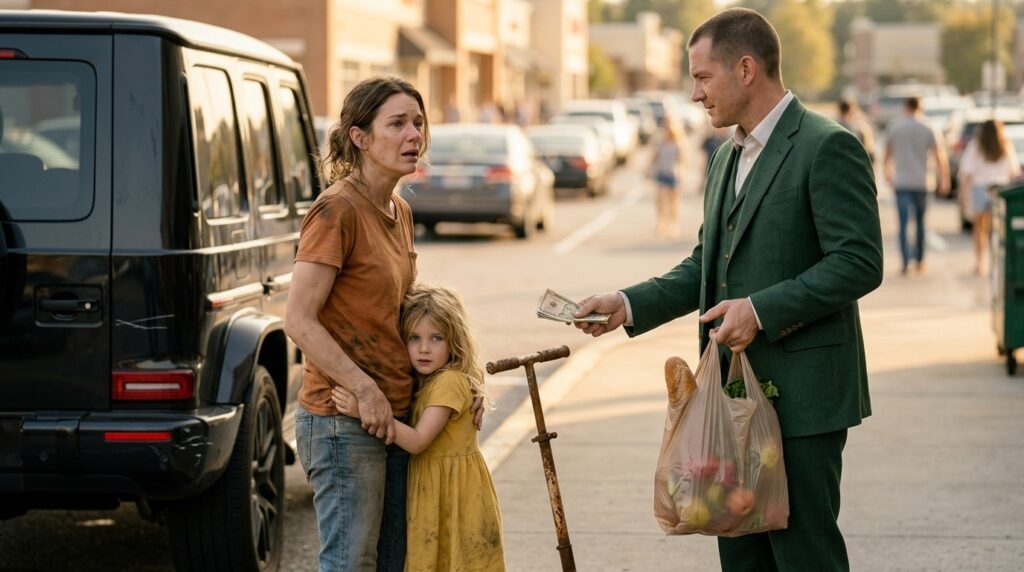
Richard was walking toward her with a plastic grocery bag hanging from one hand and something else in the other. He stopped in front of her and held out the bag. It was full — bread, a carton of juice, some canned goods, what looked like a rotisserie chicken still in its container. His grocery run. The one he’d done for himself.
In his other hand was the ten-dollar bill. And beneath it, folded together, a small stack of additional bills.
He held all of it out to her.
Elena stared at him.
“Take it,” Richard said. Simply. No performance in it.
“I can’t — “
“You already gave me something,” he said. “Most people would’ve walked away.” He nodded at the scooter. “You stayed. You offered everything you had.” He pressed the money and the bag gently into her hands. “That scratch will buff out. Take your daughter home and feed her.”
Elena stood on that sidewalk for a long moment after he’d gone, the grocery bag in one hand and more money than she’d seen in a week in the other, Maya pressed against her leg, both of them watching the black Mercedes ease into traffic and disappear.
She hadn’t expected that. She hadn’t expected any of it. She’d braced for anger — the righteous, justified anger of a man who owned beautiful things and expected the world to treat them carefully. She’d handed over her last ten dollars because it was the right thing to do and because she had nothing else to offer, and she’d told herself that was enough.
She hadn’t known it would come back.
It always surprises us, doesn’t it — the moment when doing the right thing turns out not to be the end of the story. When someone sees you doing it and decides to answer.
There’s a version of that afternoon where Richard takes the ten dollars, gets back in his car, and drives away. He would have been within his rights. Nobody would have blamed him. The scratch was real. The money was hers.
But he saw a woman hand over her last bill without hesitating, and something in him recognized what that cost. Not the ten dollars. The other thing. The part that doesn’t have a number.
And he answered it the only way that made sense.
Maya still talks about the man in the green suit. She doesn’t fully understand what happened that day. She just knows that her mother was crying, and then she wasn’t, and then there was chicken for dinner.
Sometimes that’s all a child needs to know. And sometimes, it’s more than enough.
This story was inspired by one of our viral videos. Watch the original reel below and follow KindnessHQ for daily stories that restore your faith in humanity.
This story is a fictional narrative inspired by real themes of kindness and humanity. Any resemblance to actual events or persons is coincidental.