
The bag landed at her feet like it was nothing.
The woman in the purple Lamborghini laughed, pointed, and drove away.
Rosa didn’t move for a moment. She just stood there in the heat with her broom and her orange vest and the bag sitting in the middle of the sidewalk like a question she hadn’t been asked yet.
The street was the kind of beautiful that makes you aware of your own circumstances. Palm trees ran the length of the block in two perfect rows, their shadows cutting clean lines across the pavement. The neighborhood smelled like cut grass and money — that particular combination of expensive landscaping and car wax that you only find in places where garbage trucks come twice a week and the sidewalks are power-washed. Rosa had been working this route for four years. She knew every crack in the pavement and every resident who didn’t make eye contact.
The Lamborghini was purple. Not a subtle purple. The kind that announces itself from two blocks away, the color of a woman who has never once in her life wondered whether she was taking up too much space. It had slowed as it passed her, and the window had come down, and Rosa had looked up with the careful neutrality she’d learned to wear on this street — the expression that says I am here and also I am not here, whichever you prefer.
And then the bag had come out of the window.
It hit the pavement with a weight that didn’t match what Rosa expected. Not light. Not the casual toss of someone discarding a coffee cup or a fast food bag. This had landed with a thud. A deliberate thud.
The woman in the car had laughed. Pointed right at Rosa with one manicured finger, the way you point at a joke. Then the window went up and the purple Lamborghini eased back into the lane and moved on down the palm-lined street without a second glance.
Rosa looked at the bag.
She looked at the car getting smaller in the distance.
She looked at the bag again.
Her full name was Rosa Delgado. She was 51, with hands that had been working since she was fourteen and a back that reminded her of that fact every morning. She had two kids — her son Mateo was finishing his last year of community college, and her daughter Bea had just started high school and needed new shoes and approximately a hundred other things that Rosa was quietly working through one paycheck at a time.
She crouched down.
The backpack was black, ordinary-looking, the kind you’d see on any college student. The zipper was half-open. Rosa pulled it the rest of the way.
She went still.
Inside, lined up with the clean orderliness of someone who had packed this with intention, were stacks of hundred-dollar bills. Bound with rubber bands. More of them than Rosa could quickly count. More money than she made in a year. Possibly two.
She sat back on her heels on the sidewalk of this beautiful, indifferent street and looked at what was in the bag and felt something move through her that she couldn’t immediately name — not excitement, not relief. Something more complicated. Something that had to do with the laugh. The pointing finger. The way the window had gone up without waiting to see what she would do.
She stood up.
She looked down the street.
The purple Lamborghini was maybe two hundred yards ahead, stopped at a light.
Rosa dropped her broom. It clattered against the pavement and she was already moving — not the jog of someone flagging down a taxi, but a real run, the kind that surprises you when it comes out of a body that hasn’t run in years. Her vest caught the wind. Her boots were not made for this.
She ran anyway.
In the rearview mirror of a purple Lamborghini, a woman named Vivian Cole watched a street cleaner running after her car.
Vivian was 38, the kind of wealthy that comes from building something rather than inheriting it — a logistics company she’d started at 29 with a business partner and a lease on a warehouse that she could barely afford. She wore her success the way she wore the dress she had on now: confidently, without apology, but also — if you knew where to look — with the faint residue of someone who remembered what it felt like before.
She had seen Rosa’s face when the bag landed.
She had watched the whole thing in her mirror.
The light was red. She pulled to the curb.
Rosa reached the car breathing hard, one hand pressed to her side, and knocked on the tinted window. It came down.
“I think you dropped this,” Rosa said. She was holding the bag out with both hands, her chest still heaving.
Vivian looked at her. “I didn’t drop it.”
Rosa blinked. “Ma’am, there’s — there’s a lot of money in here.”
“I know.”
“I don’t understand.”
Vivian studied her for a moment. The woman standing on the curb in the orange vest, out of breath, holding out a bag full of cash she could have simply kept — had every reason to keep — and hadn’t. She hadn’t even hesitated.
“You ran after me,” Vivian said. It wasn’t a question.
“Of course I did,” Rosa said. Like there had never been another option.
The door opened.
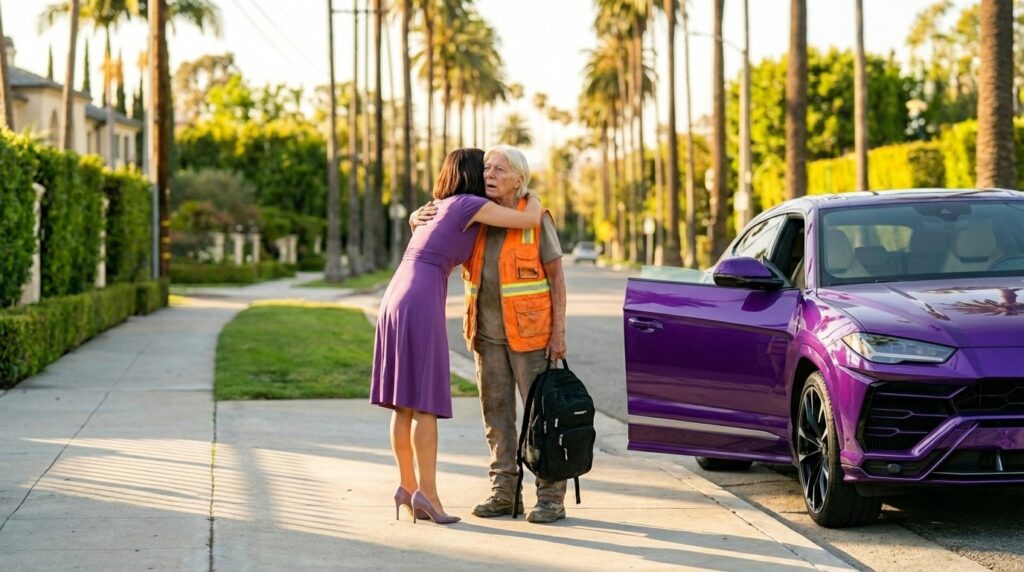
Vivian stepped out onto the sidewalk in her purple dress and her heels and she didn’t reach for the bag. She reached for Rosa. She pulled her into a hug right there on the palm-lined street, in the full afternoon sun, in front of whoever happened to be watching, and she held on for a moment longer than a polite hug lasts.
Rosa stood very still at first — the stiffness of someone who hasn’t been held by a stranger and didn’t expect to be — and then something in her settled, and she held on too.
When they separated, Vivian put both hands on Rosa’s shoulders and looked at her directly. “That bag is yours,” she said. “Every dollar. I meant it when I threw it.” She paused. “I just wanted to see what you’d do.”
Rosa looked at her. “You were testing me?”
“I was honoring you,” Vivian said. “There’s a difference.”
There are people who see a bag full of money on the ground and think: finally, something going right. There are people who look both ways, pick it up quietly, and keep moving. There are people who would spend the next hour rationalizing why keeping it was actually the fair thing, the just thing, the thing they’d earned by virtue of a difficult life.
Rosa Delgado ran after a Lamborghini in work boots in ninety-degree heat to give it back.
Not because she didn’t need it. She needed it more than most people on that street could imagine. But because it wasn’t hers, and that was the only calculation that mattered to her, and it had taken her approximately four seconds to arrive at it.
Vivian had known what she was doing when she packed that bag. She’d driven that route before. She’d seen Rosa working. She’d wanted to find someone who would run.
She found her.
Rosa Delgado took Mateo out to dinner that Friday night. Real dinner, at the kind of place where they bring you bread before you order. Bea got her shoes. And a few other things.
Rosa didn’t tell many people about the money. She didn’t post about it. She just went back to work the following Monday, the same route, the same broom, the same orange vest.
The palm trees looked the same. The street looked the same.
But something had shifted in the way Rosa walked down it — the way she held herself, the way she met the eyes of the residents who still didn’t quite look back. Not because of the money. That had already been folded into the business of living.
Because of what had happened right after she’d handed the bag back. The door opening. The arms around her. The voice saying: I see you.
Some people spend their whole lives waiting to hear those three words from someone who means them.
Rosa heard them on a Tuesday, on a sidewalk, from a woman in a purple dress.
It turns out that’s enough. It turns out that’s more than enough.
This story was inspired by one of our viral videos. Watch the original reel below and follow KindnessHQ for daily stories that restore your faith in humanity.
This story is a fictional narrative inspired by real themes of kindness and humanity. Any resemblance to actual events or persons is coincidental.