
The glass was thick enough that you couldn’t hear anything through it.
You could only watch.
And what Private First Class Marcus Webb watched, on the other side of that partition, was his father’s face do something it had never done in all the years Marcus had been alive — it broke open, completely and without warning, like a man who had spent decades holding something together and had just run out of the strength to keep doing it.
The visitation room at Haverfield Correctional smelled the way those rooms always do — industrial cleaner layered over something stale and human, the particular smell of a building that processes grief on a schedule. The fluorescent lights ran the length of the ceiling in long white strips that flattened everything they touched. The chairs were bolted to the floor. The phones on either side of the partition had that particular quality of prison phones, where every word arrives half a second late and the voice never quite sounds like the person you remember.
Marcus was 22. He had shipped out seven months ago and come back different in the ways that young men come back different — quieter in crowds, more deliberate with his words, with a stillness in him that hadn’t been there before. He was wearing his Army dress uniform, every button fastened, his cap in his lap, his back straight in the way that becomes involuntary after enough months. He had taken a bus for four hours to get here. He had not told anyone he was coming.
Across the glass, his father Raymond sat in an orange jumpsuit with his forearms on the table and his eyes moving over his son the way you look at something you weren’t sure you’d see again. Raymond was 47 but looked older. He had the kind of face that had once been handsome and still was, underneath everything — underneath the years, the bad decisions, the weight of a sentence that had taken him away when Marcus was fifteen and had not yet finished taking.
They picked up the phones.
“You’re in the Army,” Raymond said. It came out not as a question but as something between a statement and a prayer.
“Yes, sir,” Marcus said.
Raymond shook his head slowly. Not in disappointment. In something that had no clean name — something compounded of pride and sorrow in a ratio that shifts depending on the day.
“When did you — how long?”
“Enlisted right after graduation,” Marcus said. “Been in seven months.”
Raymond looked at the uniform. He looked at his son’s face. He looked at the uniform again.
“Your mother know you’re here?”
“No, sir.”
“Marcus.”
“I wanted to come alone. I wanted you to see it first.”
Raymond had been inside for six years. He had three more to go if the parole board stayed consistent, two if they didn’t. He had gotten into a car on a night when he shouldn’t have, with people he shouldn’t have been with, and the sum of those choices had cost him everything that had mattered — his marriage, his house, and the years of his son’s life that a father is supposed to be present for. The years that become the person.
He thought about that every day. He had said as much, once, in a letter he’d spent three weeks writing and then almost didn’t send. Marcus had written back in four sentences. The fourth sentence was: I know, Dad. I know.
That letter was folded in Raymond’s front pocket. It had been there for two years.
Now his son was sitting across from him in a United States Army dress uniform with ribbons on his chest and a composure that Raymond recognized — had seen it somewhere before and it took him a moment to locate it. Then he placed it. It was the same composure Raymond’s own father had carried. The kind that gets passed down whether anyone intends it to or not.
“Are you okay?” Raymond asked. “Over there. Are you okay?”
“I’m good,” Marcus said. “I’m really good.”
“You’re not just saying that.”
“No, sir. I’m not.”
Raymond nodded. He pressed his lips together.
Then Marcus did something Raymond did not expect. He reached up with his right hand and lifted the chain from around his neck. He let the dog tags pool in his palm — two small rectangles of metal stamped with his name, his rank, his branch, his blood type. The things that identify a soldier when there is nothing else left to identify him by. He pressed them flat against the glass.
Raymond leaned forward and read them.
WEBB, MARCUS A. PFC — US ARMY
He read them twice. Three times. He pressed his hand to the glass over them — over his son’s name — and his face did what it had been fighting not to do for the entire visit.
He wept. Quietly, without sound, the way men cry when they’ve spent years being careful not to. The tears came down and he didn’t wipe them. He just kept his hand pressed to the glass and looked at his son’s name on those dog tags and let it happen.
The guard at the door cleared his throat. Time.
Marcus looked up. He put the dog tags back around his neck, stood, and pressed both palms flat against the partition. Raymond pressed his back. They held that — hands to hands through glass, the closest thing to a hug the room allowed — until the guard stepped forward and Raymond was gently moved toward the door.
The door closed.
Marcus sat back down alone in his uniform in the empty visitation room. He took the dog tags off again and held them in both hands, head bowed, the way a man holds something he needs to remember the weight of.
The door opened again.
Marcus didn’t move at first. He heard it but didn’t look up — figured it was the guard telling him to clear the room, that visiting hours were done and the bus back wasn’t going to wait.
Then he heard his father’s voice.
“Marcus.”
He turned around.
Raymond was standing in the doorway in his orange jumpsuit, the guard one step behind him, and his expression was the one that fathers wear when they have run out of words and know it. For one full second neither of them moved. They just looked at each other across the small fluorescent room — the soldier and the inmate, the son and the father — and something passed between them that had been waiting six years to move.
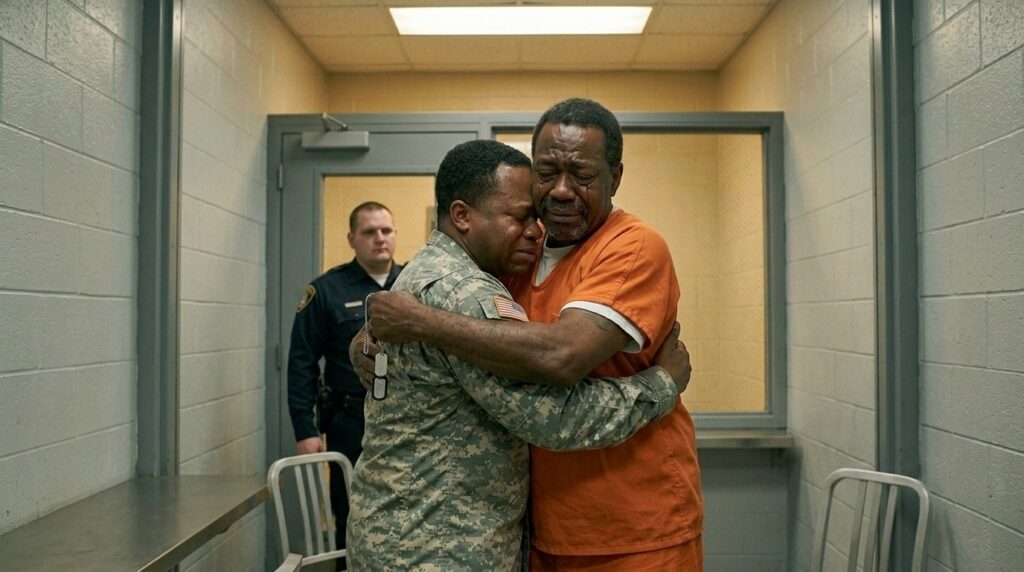
Then Marcus stood up and crossed the room, and Raymond crossed it too, and they met in the middle and held each other. Really held each other, the way men do when they’ve stopped trying to hold anything back. Raymond’s hands found his son’s shoulders, then the back of his neck, then the rigid fabric of the Army uniform, and he gripped it the way you grip something you are afraid to let go of again. Marcus pressed his face against his father’s shoulder and closed his eyes.
The guard watched from the doorway. He had worked this facility for eleven years. He had seen most things.
When they separated, Raymond took the dog tags in both hands and read them again, through tears that he no longer bothered to hide. He turned them over. He ran his thumb across the stamped letters of his son’s name.
The guard stepped forward. He extended his right hand to Marcus — not to escort him out, not to signal time was up. Just a handshake. Firm. Man to man. The kind that says: I see what you are. I see what this cost you to do.
Marcus took it.
Raymond was led back through the door. The lock engaged with the sound that locks in those buildings make — final, mechanical, matter-of-fact. Marcus stood in the empty room for a moment longer, the dog tags warm in his hand, and then put them back where they belonged.
Around his neck. Carrying his name. Carrying his father’s tears.
He picked up his cap from the chair, put it on with both hands, and walked out into the afternoon.
There are things a uniform cannot fix and things a visitation room cannot give back. Six years is six years. Three more is three more. That math doesn’t change because a son shows up in his dress greens and presses dog tags against prison glass.
But Marcus had not come to change the math. He had come to say: I turned out. I turned out and I am still here and I still carry your name and none of what happened erased you from me.
He said it without a single word.
Some things you can only say in person. Some things you can only say in a uniform you earned, on a four-hour bus ride you took alone, in a room that smells like industrial cleaner and grief.
Raymond Webb reads that letter every night. The one folded in his front pocket. The one that ends: I know, Dad. I know.
He has two years left if the board stays consistent.
His son will be there the day he walks out.
This story was inspired by one of our viral videos. Watch the original reel below and follow KindnessHQ for daily stories that restore your faith in humanity.
This story is a fictional narrative inspired by real themes of kindness and humanity. Any resemblance to actual events or persons is coincidental.