
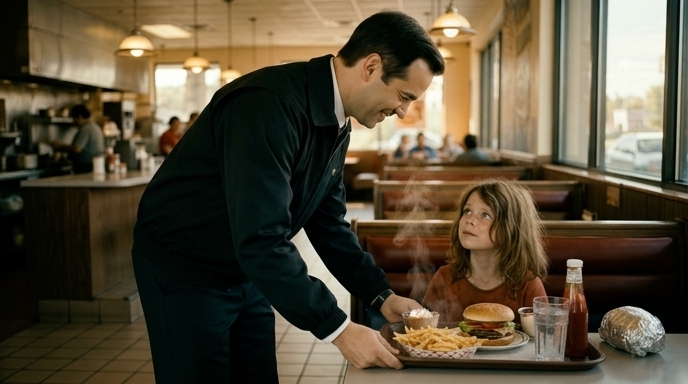
The vinyl booth offered the only shelter she had from the cold wind biting at the edges of the city. Lily sat perfectly still, her small frame pressed against the worn, red cushions, her eyes fixed on the man sitting two tables away. She prayed for him to finish his meal. She hadn’t eaten in two days, and the sight of the half-eaten fries on his plate was the only thing keeping her awake.
The restaurant smelled of stale grease, burnt coffee, and the damp, heavy scent of city trash that seemed to seep through the walls. It was a loud place, filled with the clatter of silverware against ceramic and the muffled roar of television screens showing news reports no one watched. Beneath the noise, the fluorescent lights hummed a low, persistent tune that drilled into the back of her skull. Lily ignored it all, focused entirely on the tray sitting at the table in front of the man.
He was a big man, wearing a faded yellow t-shirt that had seen better days. He chewed slowly, methodically, his gaze drifting toward the window while his fork moved between his mouth and the pile of golden, salty potatoes. To him, they were just fries. To Lily, they were the difference between another night of hollow hunger and a chance to sleep without the gnawing ache in her stomach.
The man finally pushed his chair back, the metal legs scraping harshly against the tiled floor. He stood up, grabbed his jacket, and walked toward the exit without giving the table a second glance. He left the plate behind, half the order still sitting there like a goldmine in the center of the tabletop. Lily waited, her heart hammering against her ribs like a trapped bird, checking to make sure he was actually leaving.
The door chime dinged, signaling his departure, and Lily moved. She slid out of her booth, her movements quick and practiced, fueled by a desperation that had become her constant companion. She reached the table, her hand hovering over the cold, oily remains of the meal. She could already taste the salt on her tongue.
Just as her fingers brushed the edge of the red plastic tray, a shadow fell over the table. A man in a crisp, black uniform loomed above her, his face unreadable. It was Marcus, the waiter, his hands already moving to clear the debris of the day. He didn’t hesitate. He grabbed the tray, the half-empty plate rattling as he lifted it, and marched back toward the kitchen without looking at her.
Lily froze, her hand still outstretched in the empty air. A wave of humiliation crashed over her, colder than the wind outside. She turned back to her booth, her head hanging low, the tears finally welling up in her eyes. It was stupid to hope. It was stupid to think that in a place like this, the scraps would ever belong to someone like her. She tucked herself into the corner of the booth, burying her face in her arms to hide the shame that burned in her cheeks.
The restaurant continued to churn around her, indifferent to the girl weeping in the shadows. Waiters hurried past with plates piled high, the smell of cooked food drifting through the air and mocking her hunger. She felt invisible, a ghost in a machine that didn’t have a place for her. She was just another piece of trash to be cleared away, another annoyance to be removed by the staff.
She sat there for a long time, the silence inside her growing louder than the din of the dining room. Every second stretched into an eternity. She thought about the streets, the dark corners where she slept, and the endless cycle of waking up hungry. The hope she had felt just minutes ago had been a cruel trick, a reminder of everything she didn’t have and would never be able to reach.
Marcus walked back through the swinging doors, his hands empty this time. He stopped near the kitchen, his gaze scanning the dining room. He saw the empty tables, the lingering customers, and then he saw her. He had noticed her earlier, huddled in the booth, watching the man in the yellow shirt with eyes that looked a decade older than her face. He had seen the way she had lunged for the tray, and he had seen the moment her spirit had broken.
He could have walked away. He could have finished his shift and forgotten the girl in the red dress. He had a job to do, bills to pay, and a life that demanded his attention. But he didn’t move. He stood there, the weight of the moment pressing down on him, and he realized that the world was full of people who walked past the suffering because it was easier to look away.
He walked to the counter, his mind made up. He spoke to the cook, his voice low and firm, and pointed toward the booth where Lily sat. The cook nodded, and a moment later, Marcus was back in the dining room. This time, he wasn’t clearing a table. He was carrying a tray that sagged under the weight of a full burger, a large portion of fries, and a cold drink.
He navigated the maze of tables, his eyes locked on Lily. She didn’t look up, her forehead pressed against the edge of the table, her shoulders shaking in rhythm with her sobs. She didn’t hear him approach. She didn’t realize that the world was about to shift on its axis.
Marcus stopped at the edge of her booth and set the tray down with a soft click. The smell of the food hit the air—warm, rich, and undeniably real. Lily lifted her head, her eyes wide and wet, staring at the tray. It was too much to process. It was a feast, a miracle, a kindness she hadn’t known existed. She looked up at Marcus, her mouth opening, but no words came out.
“It’s yours,” Marcus said, his voice soft, the hard lines of his face softening into a genuine, tired smile. “I’m sorry about before. I was just doing my job.”
Lily looked at the food, then at him, and the walls she had spent years building around her heart cracked. She didn’t speak. She couldn’t. She just grabbed his hand, clutching it for a second as if he were a lifeline, her grip tight and desperate. The hunger was still there, but the hollowness was gone, replaced by a sudden, jarring knowledge that she wasn’t completely alone.
Marcus leaned down, his hand resting on her shoulder for a fleeting, steadying moment. It wasn’t about the food. It was about the recognition. It was about one human being seeing another in the darkest point of their day and deciding that they were worth the effort. He turned and walked away, back to the grind of his shift, leaving her to the grace of a full meal.
Lily reached for the burger, her hands trembling. She took a bite, the flavors exploding on her tongue, and she started to cry again. But these tears were different. They weren’t tears of shame or frustration. They were tears of relief, of a body and a spirit acknowledging that, for this one moment, everything was going to be okay.
She sat in the booth, the restaurant fading into the background. She was no longer hiding. She was just a girl eating a meal, and for the first time in a long time, the future didn’t feel like a cliff she was about to fall off. The cold wind outside was still waiting, and the city would still be hard and unforgiving, but she was fortified now.
We often think that kindness has to be monumental, a grand gesture that changes the course of history. We wait for opportunities to be heroes, failing to realize that the world is changed by the small, quiet acts of people who refuse to look away. It is the decision to return to the table, to offer the full tray instead of the empty one, and to see the person hiding in the booth. Lily finished her meal, wiped her face, and stood up. She walked toward the door, leaving behind the hunger and the shame, and stepped out into the night, carrying the memory of a kindness that had saved her life.
This story was inspired by one of our viral videos. Watch the original reel below and follow KindnessHQ for daily stories that restore your faith in humanity.
This story is a fictional narrative inspired by real themes of kindness and humanity. Any resemblance to actual events or persons is coincidental.