
He opened the wallet the way you open something you already know is empty.
Slowly. Carefully. Like maybe this time the answer would be different.
It wasn’t.
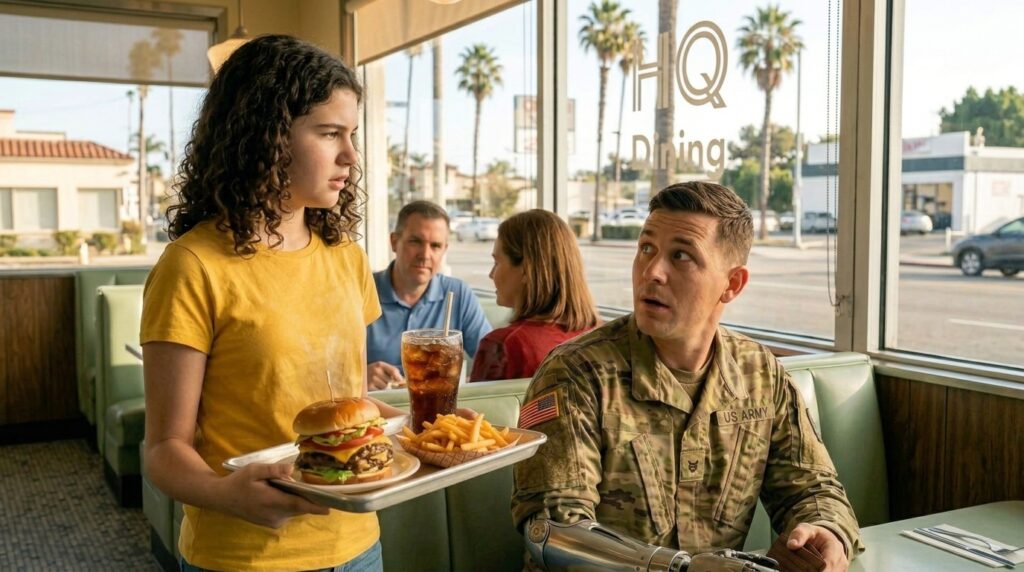
HQ Dining on a Wednesday afternoon has the particular warmth of a place that has been feeding people for decades without making a fuss about it — checkerboard floors worn soft at the center, green leather booths cracked just enough to tell their age, pendant lights hanging low over the tables throwing pools of amber that make everything underneath them look a little more golden than it actually is. The place smelled like coffee and griddle grease and the faint sweetness of pie that had been rotating in the glass case near the register since sometime that morning. Outside the window, palm trees lined the boulevard and the last of the afternoon sun cut gold across the parking lot.
Sergeant First Class Nathan Cole was 31 years old and he had come in for a burger and a Coke because he had not eaten since six that morning and because this diner was the kind of place that didn’t ask you anything when you sat down — it just brought you a menu and left you alone, which was all he had wanted from most places for the past eight months.
He was wearing his uniform. He wore it most days now, not out of ceremony but out of habit — the particular habit of a man who spent years being told what to put on his body and has not yet fully adjusted to the freedom of choosing. The U.S. Army patch on his shoulder. The name tape above his chest pocket. And his left arm, which rested on the table the way a left arm rests on a table, except that it was made of metal and carbon fiber and the kind of engineering that costs more than most people’s cars, and which Nathan had spent eight months learning to think of as his arm rather than as a thing that had replaced his arm, and was still working on it.
He had ordered the double cheeseburger and fries and a large Coke before he’d checked the wallet. He checked it now. He went through it twice, the way you go through something twice when the first answer cannot possibly be right.
Eleven dollars. The burger was fourteen ninety-five.
He set the wallet on the table and looked at it and tried to decide what to do next without making it obvious that he was trying to decide what to do next.
Two booths down, a family of three was finishing their lunch.
Tom and Carol Reeves were in their early forties — Tom in a blue polo, Carol in a red top — the kind of couple that has been married long enough to eat a meal without talking through all of it and be perfectly comfortable doing so. Their daughter Lily sat across from them. She was thirteen, with long dark curly hair that she hadn’t bothered to tie back, wearing a yellow t-shirt that was approximately the brightest thing in the room.
Lily was not looking at her food. She was looking two booths down.
She had noticed the soldier when they’d come in — the uniform, the prosthetic arm — and had watched the way he’d sat with the comfortable self-containment of someone used to being in public alone. She had watched him order. She had watched the waitress bring the menu. And she had watched, just now, the wallet come out and the face change in the small, controlled way that faces change when a person is absorbing bad news and trying not to show it.
She turned to her father.
“Dad,” she said quietly.
Tom looked up from his coffee. “Hmm.”
“That soldier over there.” She didn’t point. She just looked. “I think he can’t pay.”
Tom glanced over carefully. He looked back at Lily. “You sure?”
“He checked his wallet twice,” Lily said. “And now he’s just sitting there.”
Tom looked at his wife. Carol looked at Lily. A beat passed between the three of them that contained an entire conversation in about two seconds.
Tom unlocked his phone and slid it across the table to his daughter.
“Go ahead,” he said.
The waitress — young, in the green-striped diner uniform, white apron, the kind of efficient warmth that good diner waitresses develop after about six months on the floor — was standing at the register when she felt a tap on her arm.
She turned around. A thirteen-year-old girl with a lot of curly hair and a yellow shirt was standing beside her holding a phone.
“Can I pay for the man in that booth?” Lily said. She kept her voice low. “Without him knowing until after?”
The waitress looked at her. She looked at the booth. She looked back at Lily with the expression of someone who has just decided this is the best part of her shift.
“Absolutely,” she said.
The mobile payment screen appeared. Lily tapped it through. The green confirmation came back — Payment Successful — and Lily handed the phone back to the waitress and walked back to her booth and sat down and picked up her fork like nothing had happened.
Her mother reached across the table and squeezed her hand once without saying anything.
Nathan was still looking at the wallet when the waitress appeared at his table with the tray. The double cheeseburger. The fries. The large Coke, ice still crackling against the glass. She set it all down in front of him with the practiced ease of someone who has carried a lot of trays.
“I think there’s been a mistake,” Nathan said. “I haven’t sorted out — I need to talk to you about the bill.”
“Already taken care of,” the waitress said. She was smiling in a way that told him she wasn’t going to tell him anything else.
He looked at the food. He looked at her. “By who?”
She nodded, just slightly, in the direction of the yellow shirt two booths down.
Nathan turned.
Lily was looking at him. She hadn’t been trying to hide it. She gave him a small nod — not dramatic, not performative. Just: yes, it was me, and it’s fine, and please eat your food.
Nathan looked at her for a long moment. Something moved across his face that he didn’t try to stop — the specific expression of a man who has spent eight months being quietly brave and has just been seen, without warning, by a thirteen-year-old girl in a yellow shirt who decided he was worth seeing.
He pressed his lips together. He nodded back.
Then he picked up his burger with his right hand and his prosthetic left, and he ate.
When the Reeves family stood to leave twenty minutes later, Nathan was still in his booth. He had finished everything on the tray. He watched Lily pass his table and he did something that nobody in the diner had seen coming — and maybe Nathan himself hadn’t planned until the moment it happened.
He straightened in his seat. He brought his right hand up, clean and deliberate, and he saluted her.
Not casually. The full military salute — hand sharp at the brow, back straight, chin level — the salute that a Sergeant First Class in the United States Army gives to someone he is formally acknowledging. Someone he respects.
Lily stopped walking.
She looked at him. Her expression moved through surprise and then something quieter and more lasting. She stood up a little straighter herself — involuntary, the natural response to being looked at that way by someone like him. Then she smiled. Warm and real and not quite knowing what to do with it.
Her father put his hand on her shoulder. Her mother had already turned away because she was not going to cry in a diner on a Wednesday afternoon if she could possibly help it.
She couldn’t help it.
Nathan sat in the booth for a little while after they left. He drank the rest of his Coke. He looked out the window at the palm trees and the parking lot and the boulevard going about its business in the late afternoon light.
He thought about the girl in the yellow shirt. The way she had watched him check the wallet twice and had done the math and had made a decision without anyone asking her to. Thirteen years old. He had been thirteen once, a long time ago and in a completely different life, and he was reasonably certain that at thirteen he had not been that.
He left the diner with a full stomach and his prosthetic arm and his name tape and his uniform, and he walked out into the California afternoon, and the palm trees were still there, and the sun was still going down, and somewhere behind him in a green-striped uniform a waitress was telling her manager about the girl who had paid for the soldier’s meal and asked to stay anonymous, and her manager was listening with the expression of a man who had been in the restaurant business for twenty years and had not heard that one before.
There are a thousand ways to honor a veteran. Parades. Ceremonies. Speeches that go on longer than they should in rooms that smell like flag polish and folding chairs.
And then there is a thirteen-year-old girl in a yellow shirt who watches a man check his wallet twice and slides her father’s phone across a diner register before anyone has a chance to say someone should do something.
She didn’t make it about her. She didn’t wait for a thank you. She sat back down and picked up her fork.
The salute found her anyway.
It always does.
This story was inspired by one of our viral videos. Watch the original reel below and follow KindnessHQ for daily stories that restore your faith in humanity.
This story is a fictional narrative inspired by real themes of kindness and humanity. Any resemblance to actual events or persons is coincidental.