
She had been at that spot in Central Park for eleven years.
Same cart. Same corner of the path. Same handmade sign on a stick that said TACOS in letters she had painted herself with a brush that was too wide for the job and had used anyway because it was what she had.
Nobody had ever complained. Not once.
Central Park on a warm afternoon smells like grass and earth and the distant suggestion of pretzels from the cart two hundred yards north, and it sounds like the city deciding, briefly, to be something softer than it usually is — birds threading through the conversation of tourists, the rumble of the boulevard beyond the treeline, the particular hush of people who have come here on purpose to slow down. Rosa had stood in the middle of all of it for eleven years, and she knew every regular face on that path, and they knew hers, and that was its own kind of belonging.
Her name was Rosa Mendez. She was 64 years old, small and sturdy, with a weathered face that had earned every line on it and grey hair she kept tied back under a worn shawl that had been her mother’s. Her dress was the same faded traditional pattern she had worn for years — colourful once, softer now, the hem fraying in a place she had been meaning to fix. She made her tacos from her mother’s recipe, the same one her mother had made in Oaxaca before everything changed and Rosa had come north with two hundred dollars and a determination that had never once faltered in forty years.
She was arranging the tortillas when she felt the shift in the air that means someone is coming and they have a purpose.
She looked up.
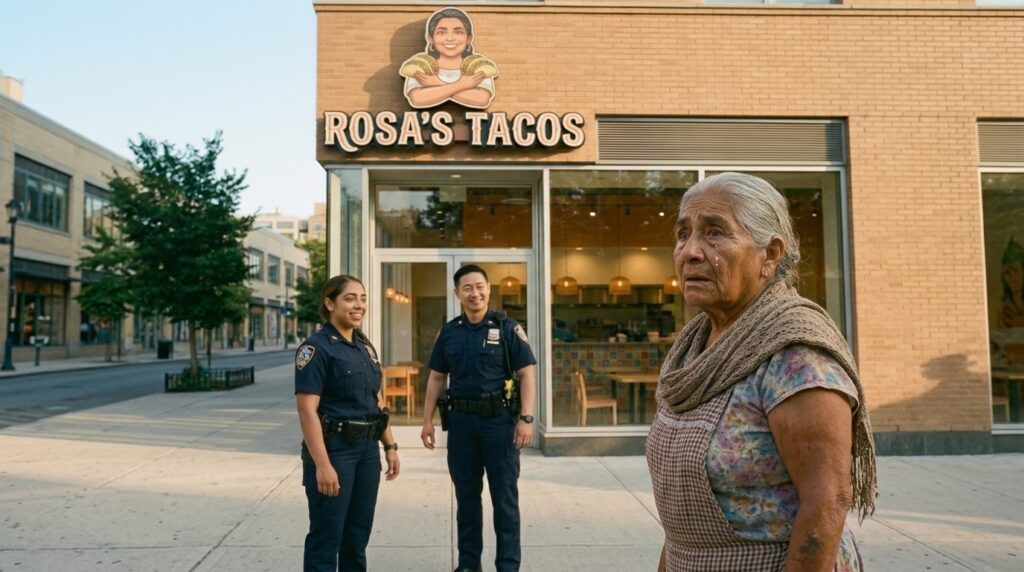
Two officers in dark navy NYPD uniforms were walking toward her along the park path. One was a Hispanic woman, early thirties, dark hair pulled back, expression professional and unreadable. The other was a younger Asian man, lean, equally unreadable. They were walking with the steady unhurried authority of people who know exactly where they are going.
Rosa wiped her hands on her shawl.
They reached her cart and stopped. The woman officer spoke. Rosa’s English was good but her face went the way faces go when authority is talking to you and the words are firm and the tone is not warm — that particular tightening, the careful neutral expression of a person trying to understand without showing fear.
“Ma’am, we need to take the cart,” the officer said.
Rosa looked at the cart. At the tacos lined up in their foil. At the sign she had painted. At eleven years of her life sitting on four wheels.
“I have my permit,” she said. “I always have my permit.”
“Ma’am.” The officer’s voice was not unkind. It was simply decided. “We need to take the cart.”
Rosa stepped back. She did not argue. She had lived long enough in this city to understand when an argument would not change anything, and she was not a woman who wasted herself on battles she could not win. She stepped back and she watched the two officers take hold of the handles of her cart and begin to wheel it away down the path.
She watched them until they turned the corner and her cart disappeared.
She stood on the path where the cart had been and looked at the empty space it had left and felt the particular cold of something being taken that you built with your hands over years.
Then the woman officer came back.
“Come with me, please,” she said. Not harshly. But not with an explanation either.
The back seat of the NYPD car smelled like vinyl and industrial cleaner and the faint ghost of every person who had sat there before her not knowing what came next. Rosa sat with her hands folded in her lap and watched Central Park pass by the window — the trees, the paths, the benches, the park she had worked in for eleven years going past the glass like a film she was no longer in.
She did not cry. She was a woman who had crossed a border alone at twenty-three with two hundred dollars and she was not going to cry in the back of a police car over a taco cart. But her jaw was tight and her hands were folded hard in her lap and her eyes stayed on the window because the window was somewhere to look that wasn’t at the partition or the officers in the front seat who had still not told her where they were taking her or why.
She thought about her mother’s recipe, written on a card she kept in the cart. She thought about whether she’d left the gas off. She thought about her regulars — the construction crew that came every Tuesday, the woman with the stroller who always ordered two, the old man with the newspaper who had never once in five years said thank you but always came back. She thought about all of it and held it carefully while the city went past the window and the car kept moving.
The car stopped.
They were on a street she didn’t know well — commercial, near the park, buildings and trees and blue sky above. The Asian officer opened the door and helped her out. Rosa stood on the sidewalk between both officers and looked at them and waited, because waiting was what you did when you didn’t have information and couldn’t make it arrive faster by wanting it.
The Asian officer stepped behind her.
She felt his hands come up over her eyes — gentle, firm, covering them completely.
“What — ” she started.
“Just a moment,” he said. And there was something in his voice now that had not been there before. Something that was not professional. Something warmer.
They walked her forward. She counted steps the way you count steps when you cannot see — six, seven, eight — and then they stopped and the hands came away from her eyes and Rosa blinked in the afternoon light and the world came back in pieces.
The sign came first.
Large letters above a shopfront she had never seen before. A cartoon illustration of a woman she recognized — small, sturdy, holding tacos with arms crossed, smiling the smile of someone who has been at it a long time and is proud of it.
The letters above it read: ROSA’S TACOS.
Her name. In large letters. Above a restaurant. With a red ribbon stretched across the entrance and glass windows showing a bright clean interior and tables she could see through the glass and a kitchen beyond that and all of it — all of it — hers.
Rosa’s hand went to her mouth.
She stood on that sidewalk and looked at her name above a restaurant door and her hand pressed against her mouth and she shook her head the way you shake your head at something your brain is refusing to process because the alternative is that it is real and if it is real then everything that has happened in the last forty minutes was not a punishment but a plan, and if it was a plan then these two people standing beside her had taken her cart and put her in a car and driven her through the park not to take something away from her but to give her something she had never once in forty years allowed herself to want because wanting it would have hurt too much.
She looked at the officers. Both of them smiling now — the professional expressions completely gone, replaced by something genuine and warm and slightly undone, the way people look when they have been carrying a secret and the secret has just landed exactly the way they hoped.
“This is yours,” the woman officer said. Simply.
Rosa turned back to the sign.
Then she walked to the entrance and picked up the scissors someone had left on a small table beside the red ribbon, and she cut it, and the ribbon fell away from the door of Rosa’s Tacos, and everyone around her cheered, and Rosa laughed the way people laugh when they have been strong for so long that joy arrives like a surprise and takes them completely off guard.
She stood in front of her restaurant that evening after everyone had gone — the officers, the small crowd that had gathered, the people who had stopped on the sidewalk to watch a woman in a faded dress cut a ribbon in front of a place with her name on it. She stood alone on the pavement and looked up at the sign in the last of the daylight.
Her mother’s recipe was in the kitchen. She had checked.
There is a kind of dignity that gets built quietly, over years, one day at a time, with a cart and a handmade sign and a recipe that came from someone who is gone. It doesn’t ask to be seen. It just shows up, every morning, and does the work.
And sometimes — not often, but sometimes — someone sees it. And decides it deserves a door.
Rosa had her door now.
She went inside to start prepping for tomorrow.
This story was inspired by one of our viral videos. Watch the original reel below and follow KindnessHQ for daily stories that restore your faith in humanity.
This story is a fictional narrative inspired by real themes of kindness and humanity. Any resemblance to actual events or persons is coincidental.