
The coins made a sound when they hit the counter.
Not loud. Just the small, specific sound of a man emptying everything he had onto a registration desk and hoping it would be enough.
It wasn’t.
Los Angeles General Hospital smells the way all hospitals smell — antiseptic and recycled air and the faint undercurrent of something medicinal that never quite leaves your lungs after you’ve breathed it. The lobby runs bright and cold, all fluorescent ceiling panels and beige tile and the low hum of an institution that processes human beings the way a machine processes parts — efficiently, impersonally, and without much room for the kind of trouble that doesn’t fit the system. It was a Tuesday morning. The waiting area was half full. A television mounted near the ceiling played a morning show nobody was watching.
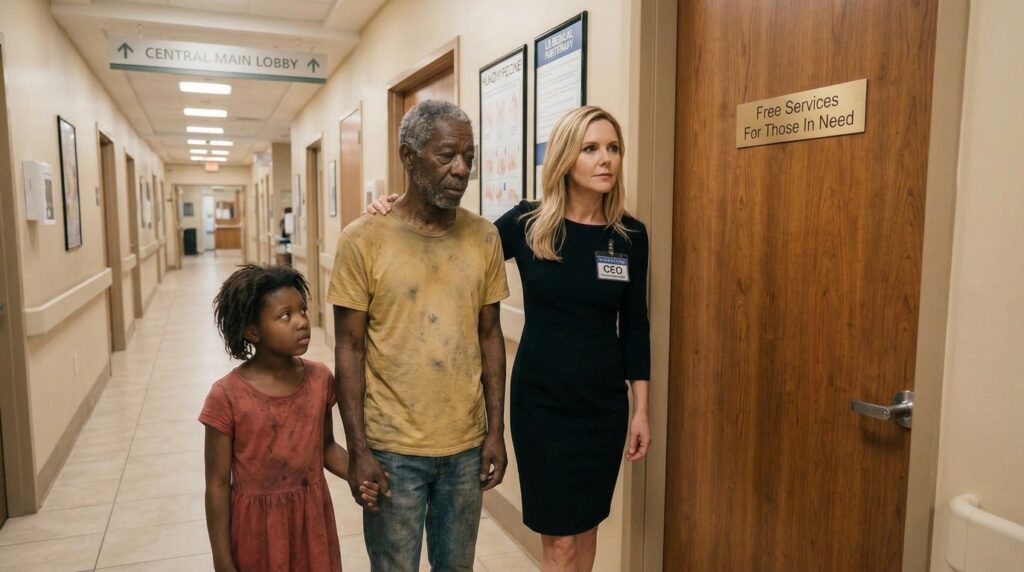
James Whitfield was 68 years old and he had walked four blocks in the August heat to get here. He was wearing his mustard-yellow t-shirt — the one with the stain near the collar that wouldn’t wash out — and his work jeans, and his heavy boots that had seen better decades. His granddaughter Amara walked beside him, seven years old, in a faded pinkish-red dress that had started its life a brighter color. She was holding his hand with both of hers the way small children hold the hands of people they trust completely.
James had been coughing for three weeks. His chest felt like something was sitting on it that wouldn’t get up. He had put off coming here as long as a man can put off something that needs to be done, because he knew what hospitals cost and he knew what he had, and those two numbers had never once in his life been close to the same.
He stepped up to the registration desk and placed the envelope on the counter. Inside was everything he had been able to pull together — coins, mostly. Some bills. He had counted it four times at the kitchen table that morning before he left.
The nurse behind the desk looked at the envelope. She looked at him.
She did not touch it.
Her name badge said Karen. She was in her forties, light brown hair pulled back in a bun, blue scrubs, the particular expression of someone who has decided before the conversation starts that they already know how it ends.
“Sir, do you have insurance?” she said. The way she said it made it clear she already knew the answer.
“No, ma’am,” James said. “But I have — I put together what I could. I just need to be seen. I’ve been coughing and my chest — “
“Without insurance or a credit card on file, we can’t process your paperwork,” Karen said. She was already looking past him at the next person in line.
“I can pay,” James said. “I have cash. I have — “
She slid the paperwork back across the counter toward him. Not aggressively. Just with the finality of a door closing.
“I’m sorry, sir. There’s nothing I can do.”
Amara looked up at her grandfather. She had been watching the whole exchange with the wide, absorbing attention of a child who understands more than adults assume, and what she had understood was that the woman behind the desk had decided they did not belong here. She pressed closer to James’s side.
James picked up his envelope. He folded it back into his jacket pocket. He had known this was possible. He had told himself, walking here, that if this happened he would handle it with dignity. He was handling it with dignity. It cost him something to do that.
Karen came around from behind the desk. She walked them toward the hallway that led to the exit — not aggressively, not cruelly, just with the brisk purposefulness of someone clearing an obstacle from a path. She gestured toward the door. She stood with her arms crossed and watched them go.
James put his hand on Amara’s shoulder and walked.
The office door on the left side of the corridor was open.
It was always open. Dr. Sandra Mercer, Chief Executive Officer of Los Angeles General, kept it open because she had learned years ago that the moment you close your door in a hospital you stop understanding what is actually happening in it. She was 46, blonde, in a black dress and heels, her CEO badge on its lanyard, and she had been standing in her doorway for the past four minutes reviewing a staffing report when James and Amara had stepped up to the registration desk.
She had not looked away since.
She watched Karen slide the paperwork back. She watched the envelope go back into the jacket pocket. She watched Amara press into her grandfather’s side. She watched Karen walk them to the hallway with her arms already crossed before she got there.
Sandra set the staffing report on her desk.
She walked out of her office.
The heat outside the hospital entrance hit James like a wall. Amara squinted against it. He was already calculating — the walk back, whether the free clinic on Seventh was open on Tuesdays, whether his chest would hold out another week if it had to.
He felt a hand on his shoulder.
He turned around.
A woman in a black dress was standing behind him, her CEO badge catching the sun. She was looking at him the way very few people in institutional buildings ever look at the people who come through their doors — like she actually saw him.
“Sir,” Sandra said. “I’m the CEO of this hospital. I need you to come back inside.”
James looked at her. “Ma’am, the woman at the desk said — “
“I know what she said,” Sandra said. “I’m asking you to come back inside anyway.”
He looked at Amara. Amara looked at the woman in the black dress and then back at her grandfather. She gave his hand a small squeeze that meant: okay.
They went back in.
Sandra Mercer walked them through the lobby with her hand resting gently on James’s shoulder — not steering him, just present, the way you walk beside someone when you want them to know they are not alone in a building that has already made them feel otherwise. She walked past the registration desk without stopping. Past the waiting area. Down the main corridor.
They stopped in front of a door.
The sign beside it read: Free Services For Those In Need.
“This exists,” Sandra said quietly. “It has always existed. You should have been told about it the moment you walked in.” She pushed the door open. “Go ahead. They’re expecting you.”
James stood in the doorway and looked at the sign for a moment. He looked back at Sandra.
“Thank you,” he said. It came out the way things come out when a person has been carrying something heavy and has just been allowed to set it down.
Sandra nodded. “Take care of yourself, Mr. — “
“Whitfield,” he said. “James Whitfield.”
“Take care of yourself, Mr. Whitfield.”
What happened at the entrance to the hospital afterward was not something James saw. He was already through the door, Amara at his side, a nurse with a warmer face already crouching down to say hello to her.
Karen had followed the corridor. She had watched Sandra walk them to the free services door. And when Sandra turned back toward the lobby, Karen was standing there — and whatever she had seen in the CEO’s face in that moment had done something to her, because she sank. Slowly, like a thing deflating. And then she was on her knees in the hospital corridor, hands together, words coming out that were part apology and part something older — the recognition that she had made a choice that morning that she could not take back.
Sandra Mercer looked at her for one long, steady moment.
Then she walked past her. Not in cruelty. In the quiet, complete way of a woman who has already decided that the conversation that matters happened somewhere else — in a corridor, in front of a door with a sign, with a man named James Whitfield and his granddaughter Amara.
That was the conversation worth having.
Everything else could wait.
James was seen that morning. His chest was examined, his cough was investigated, his paperwork was filed under a program that had existed for years and that nobody at the registration desk had seen fit to mention. Amara sat in the chair beside the examination table and swung her legs and looked at the anatomy posters on the wall and decided she had questions about how bones worked.
On the walk home, James held her hand. The August heat had not gotten any cooler. His boots were still heavy. The envelope of coins was still in his jacket pocket.
But he had been seen. Not processed — seen. By a woman in a black dress who had left her office door open and had been paying attention.
There is a kind of power that announces itself loudly — with titles and corner offices and the particular authority of people who have earned the right to look down. And then there is the other kind. The kind that opens a door that should have been open all along, and steps back, and says: go ahead.
James Whitfield went home that afternoon with a diagnosis, a prescription, and the memory of a hand on his shoulder on a hot sidewalk.
Amara went home with questions about bones.
Some doors were always open. They just needed someone with the right key to show you where they were.
This story was inspired by one of our viral videos. Watch the original reel below and follow KindnessHQ for daily stories that restore your faith in humanity.
This story is a fictional narrative inspired by real themes of kindness and humanity. Any resemblance to actual events or persons is coincidental.