
The engine sputtered and coughed, a dying mechanical wheeze that echoed off the suburban fences. Sarah gripped the grease-stained handlebars of her rusted motorcycle, dread sinking into her stomach the moment she saw the flashing blue and red lights dancing in her rearview mirror. She pulled over, her heart hammering against her ribs like a trapped bird. This was the moment she had been avoiding, the inevitable collision between her broken-down reality and the rigid laws of the road.
She killed the ignition and let the machine settle. The bike was a relic, a collection of corroded metal and failing parts that held together by sheer willpower and wire. It rattled even when it was standing still. The patrol car pulled up close, the aggressive stance of the cruiser making her feel small and exposed. Sarah sat there, her hands trembling, staring at the patch on the officer’s sleeve. She didn’t want a conversation. She didn’t want to explain why she was riding a machine that looked like it belonged in a junkyard.
The driver’s side door swung open, and the officer stepped out. He was tall, his uniform pressed and immaculate, a stark contrast to the dust-caked grime covering Sarah’s denim jacket and worn-out jeans. He didn’t offer a polite greeting. He didn’t ask how her day was going. He walked straight toward the motorcycle, his eyes locked on the front tire, then the engine block, then the seat. He moved with a clinical, detached precision that made Sarah’s skin crawl.
“Step off the bike,” he said. His voice wasn’t aggressive, but it was absolute.
Sarah climbed down, her legs feeling heavy. She stood on the pavement, watching him inspect the machine. He gripped the handlebars, checked the mirrors, and shook the frame. He was evaluating it, judging the structural integrity of every bolt and weld. Sarah braced herself for the fine, for the lecture about safety regulations, for the inevitable demand that she walk the rest of the way home. She waited for the sound of a citation book snapping open.
Instead, the officer pushed the bike. He moved it away from the curb, away from the street, and rolled it toward the back of the building. He stopped in front of a massive, overflowing metal dumpster. Sarah’s breath hitched. She watched in disbelief as he unceremoniously heaved the heavy, rusted machine over the edge. The sound of metal hitting metal was deafening, a hollow, final clang that signaled the death of the only thing Sarah relied on.
He didn’t look back at her. He walked away, climbed into his cruiser, and drove off, leaving her standing there in the middle of the sidewalk. The silence that followed was heavier than the noise of the engine had ever been. She stood rooted to the spot, her eyes fixed on the rim of the dumpster where her bike had disappeared. It wasn’t just a vehicle; it was the symbol of her persistence, the thing that got her to work, to the store, to nowhere—it was her independence, and now it was gone, discarded like trash.
The shock began to fade, replaced by a cold, sharp sting of betrayal and sorrow. Sarah crumpled onto the curb, burying her face in her hands. The tears came quickly, hot and angry. She felt completely stripped, laid bare by an authority figure who had decided, without a single word of explanation, that her struggles didn’t matter. She sat there for a long time, the afternoon sun beating down on her shoulders, feeling the sting of the asphalt against her boots. She didn’t have the energy to stand up. She didn’t have the energy to go anywhere.
She was lost in the haze of her own frustration, replaying the moment the officer’s hands gripped the handlebars, the way he tossed the bike into the dumpster without a hint of hesitation. Every passing car felt like a judgment. She was a woman on a curb, crying over a piece of scrap metal that had been taken away, feeling the profound weight of being invisible in a world that only saw what was broken. She closed her eyes, trying to block out the street, the houses, and the memory of the uniform.
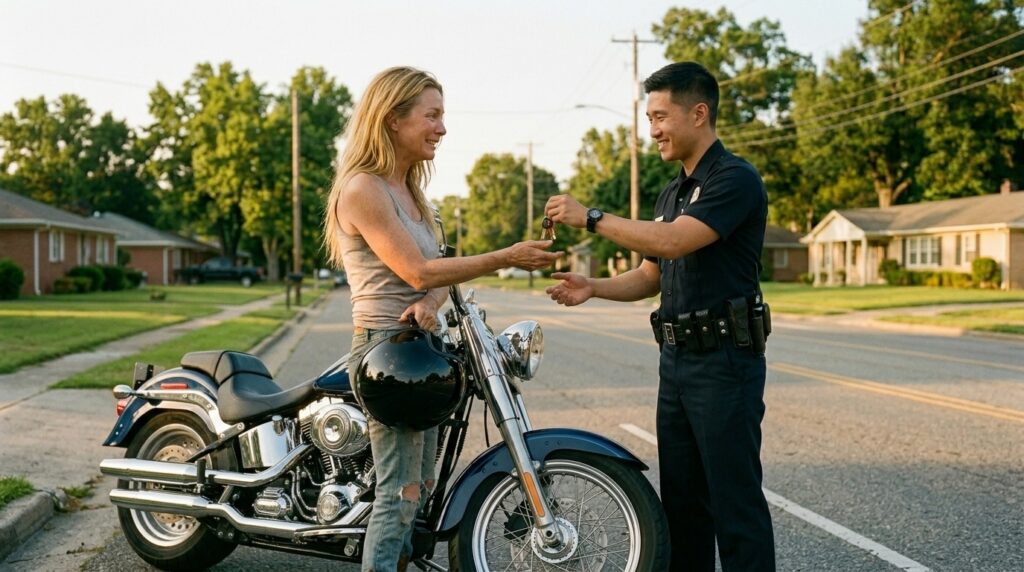
The sound of a powerful, rhythmic engine broke her focus. It wasn’t the sputtering, uneven chug of her old bike. This was a smooth, deep thrum that vibrated through the ground. Sarah wiped her eyes, her vision blurry, and looked up. The patrol car was back, but the officer wasn’t in it. He was sitting on a machine that gleamed in the sunlight, reflecting the blue sky and the trees around them. It was beautiful, polished to a mirror finish, and looked like it had never touched a dirt road in its life.
The officer pulled up, killed the engine, and stared at her. He didn’t say anything, but his expression had shifted. The cold, detached mask he had worn earlier was gone, replaced by a quiet, steady resolve. He held out the keys to her, the metal glinting in the light.
“I couldn’t watch you ride that death trap another day,” he said, his voice softer this time, edged with a gentleness that surprised her.
Sarah stared at the keys, then at the bike, then back at him. She was speechless. The man who had stripped her of her old life had returned to hand her a new one. He didn’t wait for a thank you. He didn’t wait for her to understand the logistics of how or why. He simply stepped back, leaving the new bike there as a silent commitment to her future.
The transformation was immediate. As she reached out and took the keys, she felt the weight of the past fall away. It wasn’t just about the machine. It was the realization that someone had been paying attention all along. He had seen the struggle, he had seen the danger, and he had made the choice to act, even when it looked like he was the villain of her story. In that moment, the tears stopped, and a sense of profound, quiet strength took their place.
True respect is rarely about what is said; it is about the actions taken when the world isn’t watching. It is the ability to recognize when someone is at their breaking point and to intervene not because you have to, but because you choose to change the narrative. Sarah realized then that she wasn’t just being given a new way to get around; she was being given permission to believe that things could actually get better.
This story was inspired by one of our viral videos. Watch the original reel below and follow KindnessHQ for daily stories that restore your faith in humanity.
This story is a fictional narrative inspired by real themes of kindness and humanity. Any resemblance to actual events or persons is coincidental.