
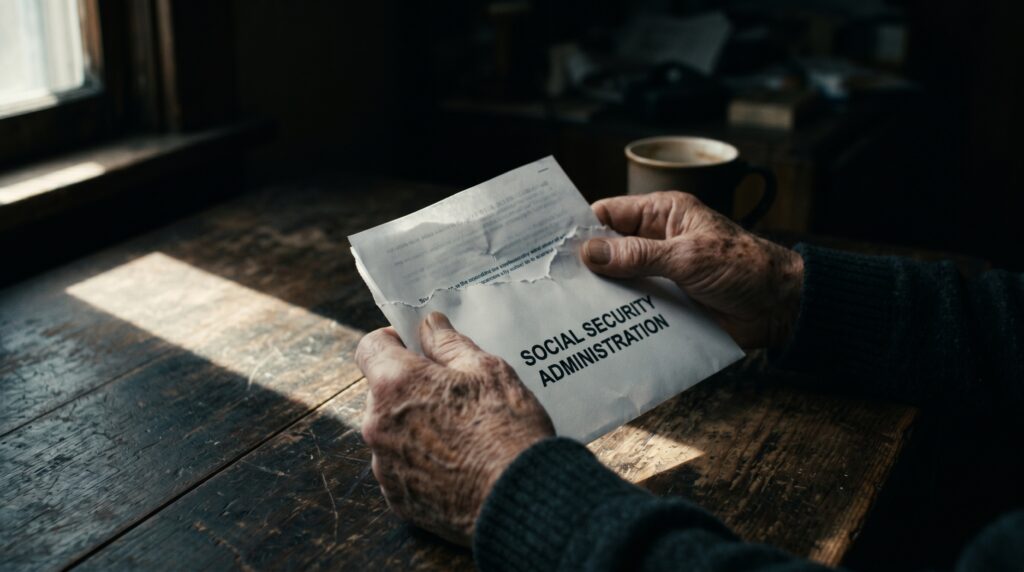
The envelope had been sitting on the kitchen table for six months.
Harold never opened it. He assumed it was junk — one of those official-looking mailers that turned out to be a credit card offer or a Medicare supplement pitch. He was 71 years old and had been throwing away envelopes like that his entire life.
He died on a Tuesday in October, in the same recliner where he watched the evening news every night for thirty years.
His son, Patrick, flew in from Denver the following Thursday. He wasn’t close with his father — not in the way either of them had wanted, but in the complicated way that happens when a man works doubles his whole life and a boy grows up mostly in the company of a television set. Harold had driven a city bus for the Chicago Transit Authority for forty-three years. He never called in sick. He never asked for anything.
Patrick found the envelope while clearing the kitchen table on his second day there.
The return address said: Social Security Administration.
He almost threw it away too.
The kitchen smelled like instant coffee and old newspapers. Outside, the October wind pushed dead leaves against the window glass with a sound like quiet applause. Patrick stood at the counter in his father’s house — the house he’d grown up in, the house with the sticky third stair and the radiator that clanged every winter — and he slid his finger under the flap.
He read it once. Then he sat down.
Then he read it again.
The letter was a notice of underpayment.
For six years — from the day Harold turned 65 until that October — the Social Security Administration had been paying him $580 less per month than he was legally entitled to receive. The reason was a paperwork error made during his initial enrollment. A single transposed digit on a form had caused the system to miscalculate his lifetime earnings record.
The letter wasn’t a threat. It wasn’t a demand.
It was an apology, and a check for $41,760.
Patrick held the check in both hands like it might dissolve. His father had lived his last six years on $1,240 a month. He’d skipped his blood pressure medication twice because of the cost. He’d eaten oatmeal for dinner four nights a week and told Patrick on the phone that he “just wasn’t that hungry anymore.”
He never knew.
Patrick called the Social Security Administration the next morning. He was on hold for forty minutes. When a woman named Diane finally picked up, he explained the situation in a voice that kept almost breaking.
“My father passed away five days ago,” he said. “I’m looking at a check made out to him for forty-one thousand dollars and I need to understand what happened.”
Diane was quiet for a moment.
“I’m very sorry for your loss,” she said. “I see the account. The correction was flagged by our audit department in April. The notice should have been sent much sooner. I’m sorry it wasn’t.”
“He never opened it,” Patrick said.
Another silence.
“I know,” Diane said quietly. “A lot of them don’t.”
That sentence stayed with Patrick for a long time.
A lot of them don’t.
He hired a Social Security benefits attorney the following week — not for himself, but because something Diane had said wouldn’t leave him alone. The attorney, a woman named Carol Reyes who had spent twenty years working exclusively with retirees, sat across from him in her office and laid out a reality that felt like a second grief.
“Your father’s case isn’t unusual,” she said, sliding a legal pad across the desk. “It’s not even rare. We see this constantly. Enrollment errors, spousal benefit miscalculations, delayed filing penalties that were applied incorrectly.” She paused. “Most people don’t audit their own Social Security statements. They assume the government got it right.”
“Why wouldn’t they?” Patrick said.
Carol looked at him steadily.
“Because the government is handling 70 million beneficiaries,” she said. “And the people most likely to have errors are the ones least likely to know they can check.”
Patrick requested his father’s complete Social Security earnings record. It took three weeks to arrive.
The error was exactly what Diane had described — a transposition during the original enrollment that had quietly shaved $580 off every monthly payment for six years. Simple. Invisible. Devastating in slow motion.
But Carol found something else.
Harold had been married briefly in his twenties — a marriage that lasted four years and ended quietly, the way young mistakes sometimes do. His ex-wife, a woman named Ruth, had passed away in 2019. Harold had never claimed the survivor benefit he was entitled to as a divorced spouse. He didn’t know it existed.
The additional unclaimed benefit amounted to $214 per month going back to Ruth’s death.
Another $70,000, sitting uncollected in a system Harold had paid into his entire working life.
Patrick sat in Carol’s office for a long time after she finished talking. The afternoon light came through the blinds in long flat lines. He thought about the oatmeal dinners. He thought about the blood pressure medication. He thought about a man who drove a bus through Chicago winters for forty-three years and never once asked anyone for anything he hadn’t earned.
“Can I still claim it?” Patrick asked. “Now that he’s gone?”
Carol set down her pen.
“Some of it,” she said carefully. “Not all. That’s why I tell every family I work with — check the statements while they’re still here. Not after.”
Patrick did eventually recover a portion of the underpayment through the estate. The process took eight months and required a probate attorney in addition to Carol’s help. He recovered $58,000 of the total $111,000 his father had been shorted.
The other $53,000 was gone. Uncollectable. A number on a form that had nowhere left to go.
He used the recovered money to pay off his father’s remaining medical bills and donate a bench in Harold’s name to the bus depot where he’d worked. A small bronze plate. His name and his years of service.
It wasn’t the ending Harold deserved.
But it was the one Patrick could give him.
There is a generation of men in this country who were raised to believe that asking questions about money was somehow undignified. That trusting the system was the same as being taken care of by it. Harold wasn’t naive. He wasn’t careless. He was a man who worked hard and assumed the math would take care of itself.
It didn’t.
And somewhere right now, there is another Harold sitting in another recliner, watching the evening news, with an envelope on his kitchen table that he hasn’t opened yet.