
The box was empty before it hit the bottom of the bin.
She didn’t look back. Why would she? It was just a pizza box, and the day was warm, and the red Ferrari was thirty feet away, and there was somewhere to be.
She didn’t see the woman on the bench watching.
The parking lot that afternoon had the particular stillness of suburban spaces on sunny weekdays — the kind of quiet that sits between the hum of distant traffic and the sound of birds that have not been told to stop. The asphalt was clean and white-lined, the trees behind the lot ran green and full, and along the landscaped strip between parking spaces a wooden bench sat surrounded by flowering peony bushes in pink and white bloom, the kind of accidental beauty that appears in ordinary places and goes unnoticed by most people most of the time.
The woman on the bench had been noticing them all morning. When you have been outside long enough, you notice things that people in a hurry do not.
Her name was Margaret. She was seventy-three, with long grey-white hair that had come loose from wherever she’d tried to put it, and she wore a beige zip-up jacket over dirty cargo trousers and dark work boots that had spent more time on pavement than they were ever designed to. Her belongings — folded, bundled, organized with the careful precision of someone for whom organization is the last form of control available — sat on the bench beside her. She had been sitting here since the morning grew warm enough to make it bearable.
She watched the woman in the grey suit drop the pizza box into the black metal bin beside the bench.
She watched the grey suit and the nude heels and the blonde hair walk back toward the red car that cost more than Margaret had made in any five years of her working life.
She waited until the footsteps got far enough away.
Then she got up.
Her name, the woman in the grey suit, was Claire Weston. She was thirty-eight, worked in commercial real estate, and had the kind of life that moved fast enough that stopping was something you had to consciously decide to do. The pizza box was from lunch. She had eaten half and forgotten the other half in the passenger seat and had been meaning to throw it away since noon.
She was almost at the Ferrari when something made her turn around.
She didn’t know what, exactly. Not a sound. Not a call. Just the particular pull of peripheral awareness — the sense that something behind you is worth looking at.
She turned.
The elderly woman was at the bin. Both hands on the pizza box. Lifting it out with the careful deliberateness of someone who has learned that hope is a resource to be managed carefully — not spent all at once, not wasted on things that probably won’t work out.
She opened the box.
Claire watched her look inside. Watched the hope in her body go out the way a light goes out — not dramatically, not with a sound, just suddenly not there. The box was empty. The elderly woman stood holding it with both hands, looking at the grease-stained cardboard, and Claire understood in one complete, unambiguous moment exactly what she was seeing and exactly what it meant.
She did not move. Not yet. She just stood in the parking lot in her grey suit and her nude heels and watched.
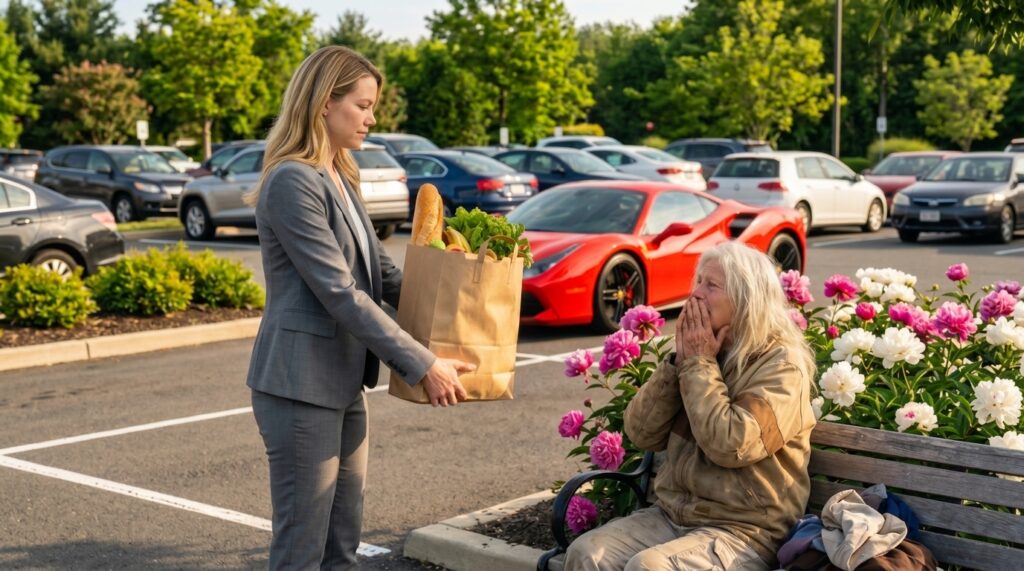
Margaret set the box down on the bench. She stood beside it with both her weathered hands raised to her face — covering her eyes, head slightly bowed, the posture of a woman who has run out of the energy it takes to hold herself upright in a feeling. Behind her the peony bushes bloomed pink and white in the afternoon sun, beautiful and completely indifferent, the way beautiful things are sometimes.
She stood like that for a long moment.
Twenty feet away, Claire Weston made a decision.
It was not a difficult decision, which is perhaps the most important thing about it. It did not require a conversation with herself or a cost-benefit analysis or the weighing of what it would cost against what she had that afternoon. She looked at an old woman standing with her face in her hands in front of a flowering bush on a Tuesday, and she turned around, and she walked back to the Ferrari, and she opened the door.
The grocery bag was in the passenger footwell where she’d put it after the supermarket that morning. Organic baguette, leafy greens, a couple of cans, some packaged things she’d bought without a specific plan. She lifted it with both hands — heavy, full, the paper handles warm from the car interior — and she turned and she walked back across the parking lot.
Her heels on the asphalt made a sound in the quiet lot.
Margaret heard them coming. She lowered her hands from her face and turned.
The woman in the grey suit was walking toward her carrying a large brown paper bag that Margaret could see was full — could see the top of a baguette, something green, the weight of it in the way the woman carried it with both hands held steady. She was walking directly toward her. She was not walking past.
Margaret’s hands came up to her mouth.
“Here,” Claire said. She held the bag out with both hands, the same hands that had thrown away a pizza box twelve minutes ago, and she looked at Margaret directly and without ceremony. “I want you to have this.”
Margaret looked at the bag. She looked at the woman. She looked back at the bag and the tears came without warning — the kind that arrive before you have decided to cry, that are simply the body’s honest response to something it did not expect.
“I can’t — ” Margaret started.
“Please,” Claire said. Just the one word. No speech. No explanation of herself or her choices or what had moved her. Just: please.
Margaret’s hands came out and she took the bag and held it against her chest and stood there in the parking lot beside the flowering bushes with a bag full of food pressed against her heart and the afternoon sun warm on her face, and something moved through her that was not just gratitude — something older and more complicated, the specific feeling of being seen by someone who had no obligation to look.
She looked up at Claire.
Claire looked back at her.
Then Margaret set the bag carefully on the bench and she stood up straight and she opened her arms, and Claire Weston in her grey suit and her nude heels stepped forward and held a stranger in a suburban parking lot on a Tuesday afternoon, and neither of them said anything, because there was nothing that needed to be said that the moment hadn’t already said better.
The red Ferrari was still there when they separated. Still parked in the lot, still unmistakably itself, still the kind of beautiful that makes you aware of the distance between lives.
Claire picked up her bag from where she’d set it on the asphalt and walked back to the car. She got in. She looked in the rearview mirror once — Margaret was sitting back on the bench with the grocery bag beside her, her hand resting on the top of it, the pink flowers all around her, the afternoon going on.
Claire drove away.
There is a version of that Tuesday where Claire reaches the Ferrari and gets in and the day continues and Margaret opens an empty pizza box on a bench and that is the whole story. It is the more likely version. It is the version that happens most of the time.
But Claire turned around. She saw what was happening and she turned around before she had decided to turn around, and the rest followed from that.
One turn. Thirty feet across a parking lot. A bag of groceries from the passenger footwell.
That is the entire distance between a story that ends at a trash can and a story that ends with two women holding each other in front of flowering bushes.
Margaret ate that night. She sat on her bench in the last of the afternoon light and she ate, and the peony bushes bloomed around her in pink and white, and the parking lot went quiet as the day ended.
She had stopped counting the days a while back.
That one she counted.
This story was inspired by one of our viral videos. Watch the original reel below and follow KindnessHQ for daily stories that restore your faith in humanity.