
He was holding the sign with both hands when they appeared at the end of the block.
He saw the uniforms first. Then the badges catching the afternoon light. Then the way they were walking — steady, deliberate, with the particular direction of people who have already decided where they are going and why.
He gripped the sign a little tighter and waited.
The city street smelled like exhaust and the warm flat smell of concrete that has been in the sun all day, with the distant suggestion of something frying from the restaurant two doors down. Traffic moved without stopping. A woman pushed a stroller past without looking at him. He had been sitting here since eight that morning — the same square of sidewalk, the same piece of cardboard under him, the same hand-lettered sign that said ANY HELP in letters he had printed as clearly as he could because legibility felt like the last kind of dignity available to him.
His name was Darius Cole. He was 31 years old, short dark hair, clean-shaven, wearing a faded pink hoodie that had been a different color once and jeans that had given up trying to look like jeans some time ago. He had a cousin in the Bronx who didn’t have the room and a storage unit in Queens that held what remained of a life that had come apart eighteen months ago with a combination of a layoff and a landlord and a sequence of small disasters that had each seemed survivable until they weren’t.
He had been here eleven days. He was trying not to count them.
The two officers stopped in front of him.
Officer Marcus Chen was thirty-three, Asian American, strong build, the kind of face that defaulted to serious the way certain faces do. Officer Rachel Voss was thirty, blonde hair pulled into a ponytail through the back of her cap, glasses, with the particular energy of someone who did everything at exactly the right speed. Neither of them was unkind. Neither of them was warm. They were simply there, and official, and looking at him.
“Sir,” Chen said. “I’m going to need to take the sign.”
Darius looked at the sign in his hands. He looked at Chen. “I’m not doing anything wrong,” he said. “I checked. I can be here.”
“I understand that,” Chen said. He crouched down and reached forward and took the sign from Darius’s hands with the practiced efficiency of someone who has learned to do difficult things without inflection. He set it on the pavement beside them.
Darius looked at the empty space where the sign had been. He looked at his empty hands. He raised them slightly, palms out, the universal gesture that means: I am not a threat, I have nothing, please see that.
“Can I ask what this is about?” he said.
Neither officer answered. Voss gestured for him to stand.
He stood. Slowly, unsteadily, the way you stand when your legs have been folded under you for hours and when the act of standing is freighted with implications you haven’t been told about yet. He looked between both officers with the wide careful eyes of a man trying to read a situation that is not giving him enough information.
“Come with us, please,” Chen said.
It was not a question.
The back seat of the police cruiser smelled like vinyl and something industrial and the particular neutrality of a space designed to hold people who are not passengers. The metal cage divider sat between Darius and the front seats and the city moved past the window and he pressed his fingers flat on his thighs and tried to think clearly.
He had not been handcuffed. That was something. He kept coming back to that.
But the sign was gone and he was in a police car and the cage was in front of him and through the window Central Park was going past on the right and then they were on a cross street he didn’t know well and the world outside continued doing what the world outside does, which is nothing in particular, which is everything.
He wiped his eye with the back of his hand. He was not going to do this. He had lasted eleven days on a sidewalk in New York and he was not going to do this in the back of a police cruiser.
He did it anyway. Quietly, without sound, the way you do when you have run out of the energy it takes to hold things in.
The car stopped.
Chen opened the rear door and helped him out into the afternoon. Darius stood on the sidewalk between both officers and looked around at a block he didn’t recognize — commercial, city buildings, a coffee shop on the corner, trees — and waited again, because waiting was the only option available.
Then Chen stepped behind him.
He felt both hands come up over his eyes from behind — warm, firm, blocking everything.
“What — ” Darius started.
“Almost there,” Chen said. And something in his voice was different. Something that had not been in his voice on the other sidewalk, in front of the empty sign, during any of the preceding twenty minutes. Something that was not professional distance.
Something that was barely suppressed excitement.
They walked him forward. He counted six steps and then they stopped and the hands came away and Darius blinked in the afternoon light and the world came back.
The stall was right in front of him.
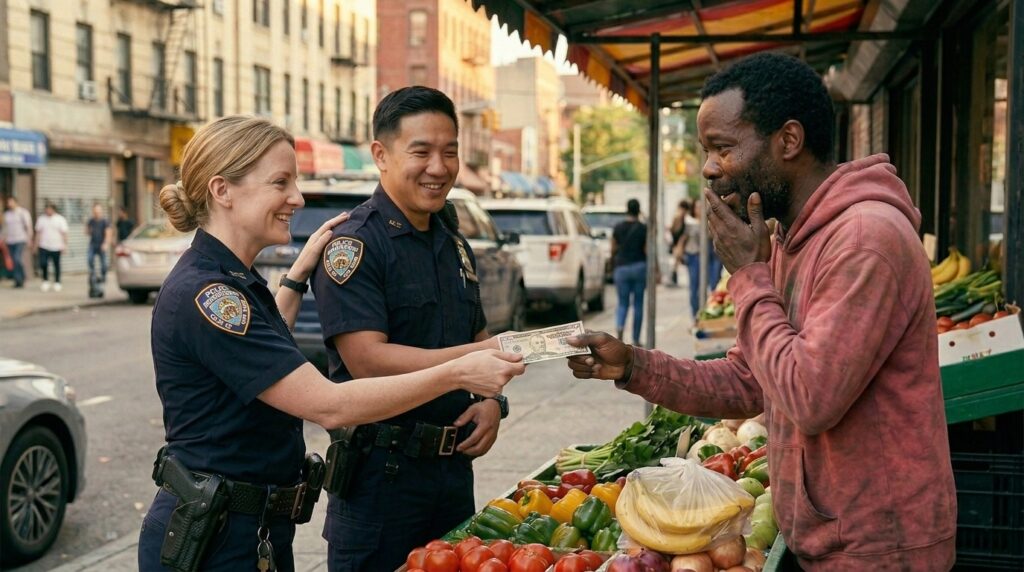
Wooden frame, colourful canopy, the whole front of it arranged with tomatoes and cucumbers and peppers and leafy greens and a bunch of ripe yellow bananas sitting at the front like they were waiting to be the first thing he noticed, which they were. A small handwritten price sign. A clean counter. A stall that was real and present and completely, unmistakably set up and ready for business.
His stall.
Darius didn’t move. He stood in front of it and his mouth opened slightly and he looked at the produce and then at the officers and then at the produce again and the expression on his face went through several things very quickly — incomprehension, then the beginning of comprehension, then the specific terror of comprehending something good when you have stopped trusting good things, then the comprehension winning anyway.
“This is yours,” Voss said. She was smiling the way people smile when they have been waiting a long time to say something. “We set it up this morning. The permit’s paid for the year. The stock is yours. Everything on that stall is yours.”
Darius took one step forward. He reached out and touched a tomato. Just to confirm it was real. It was.
He stepped behind the counter.
He stood behind his own stall on a city street in the afternoon light and looked out at the sidewalk from the other side of a counter for the first time in eighteen months and something moved across his face that had no clean name — something that lived in the territory between disbelief and recognition, between grief for the time lost and something that was starting, very cautiously, to feel like its opposite.
Chen reached forward and picked up the bunch of bananas. He put them in a small paper bag and set it on the counter.
Then he reached into his pocket and produced a fifty-dollar bill. He laid it on the counter in front of Darius.
“First sale,” he said.
Darius looked at the bill. He looked at Chen. He looked at Voss, who had her hand over her mouth and was not entirely succeeding at keeping her composure, which meant that Darius did not succeed either, and the tears came now without apology — real and full and the kind that have been waiting a long time for the right moment, which this was.
Chen put his hand on Darius’s shoulder briefly. Just once. The gesture of a man who has just watched something work out the way it was supposed to and is not going to make a speech about it.
“Take care of yourself,” he said.
The police cruiser pulled away down the street a few minutes later. Darius watched it go from behind his stall, one hand raised high, waving until it turned the corner and disappeared. Then he turned back to his produce and stood there for a moment, both hands resting on the counter, looking at what was in front of him.
A woman stopped. She looked at the bananas. She looked at the tomatoes. She opened her bag.
“How much for the tomatoes?” she said.
Darius told her.
She bought four.
Eleven days is not a long time. It is also, in certain circumstances, a very long time. It is long enough to forget what it feels like to stand behind a counter instead of in front of a wall. Long enough to start believing that the sidewalk is permanent. Long enough that when something changes, it takes a moment to trust that the change is real.
Two officers had taken his sign and put him in a car and he had sat in the back seat wiping his eye and told himself to hold on, hold on, hold on.
He had held on.
And on the other side of all of it was a stall full of produce and a fifty-dollar bill and a woman asking about tomatoes and the afternoon sun coming down warm on a street that was now, in some small but completely real way, his.
He straightened the bananas.
He waited for the next customer.
This story was inspired by one of our viral videos. Watch the original reel below and follow KindnessHQ for daily stories that restore your faith in humanity.